
Avila at Third? Not All That Uncommon in Tigers History

Tonight Alex Avila is the Tigers’ starting third baseman in the opener of a three-game series in Denver against the Rockies.

Avila’s never played third in the majors but he’s not the first Tigers player to be pressed into action there. Did you know that Al Kaline appeared in two games at third during his career?

In 1961, he played a full nine innings at third, fielding a pair of chances cleanly, with a putout and an assist. Four years later he played 5.1 innings of a game with three chances, two putouts and an assist.

Johnny Wockenfuss, who played mostly at first, catcher and in the outfield, became even more of a utility man for Sparky Anderson when he played … parts of two games – all of 2.1 innings – at third base but never saw any action.

Like Kaline, in 1965 Willie Horton played third but outlasted him be two-thirds of an inning. In one game he played six innings, fielded two chances and earned an assist on both.

Others taking a turn at the hot corner include:

  • Mickey Stanley: 18 games over two seasons (1975 and ’76), 61 chances, 13 putouts, 46 assists and two errors
  • Alan Trammell: 43 games in two seasons (1993, ’96), 100 chances, 26 putouts, 69 assists, five errors
  • Ty Cobb: 1 game in 1918, two chances, with an assist and a putout.
  • Charlie Gehringer: 6 error-free games (and 26 chances) in 1926 for The Mechanical Man

I’m looking forward to this experiment. Having Avila’s bat in the lineup is huge and having him at third, well, can’t be any worse than Ryan Raburn.

What do you think?

The Mysterious Enos Cabell

I love “where-are-they-now” pieces as much — and probably more — than the next guy.

cabell_enosSo, when I saw Tom Gage’s piece about Enos Cabell over the weekend, I was interested to read why Cabell, who hit .311 for the 1983 Tigers, moved on after that season.

He wanted to stay a Tiger, and they weren’t averse to him staying.

“But they wouldn’t give me a raise,” Cabell said Saturday. “I hit .311, played with a knee brace the last two months of that year, and they wouldn’t give me a penny more.

“So I said bye-bye. I was pretty sure the Astros wanted me back, anyway.”

As Rob Neyer might say, well, maybe. I remember there was talk about Cabell having a drug problem and that Sparky Anderson wanted none of that in his clubhouse. Then, in 1986:

Commissioner Peter Ueberroth gives seven players who were admitted drug users a choice of a year’s suspension without pay or heavy fines and career-long drug testing, along with 100 hours of drug-related community service. Joaquin Andújar, Dale Berra, Enos Cabell, Keith Hernandez, Jeffrey Leonard, Dave Parker, and Lonnie Smith will be fined 10 percent of their annual salaries to drug abuse programs. The commissioner also doles out lesser penalties to 14 other players for their use of drugs.

Somewhere in the middle is the truth, right?

Meet the Kinder, Gentler Kirk Gibson

The next best thing to Kirk Gibson being the Tigers’ manager is watching him lead my local team, the Diamondbacks. He’s getting lots of attention as the Dbacks arrive in camp as 2011 marks his first full season as the club’s skipper.

The focus seems to be on how he and his staff, which includes bench coach Alan Trammell, will shape this relatively young team — Melvin Mora notwithstanding — and emphasize the positive.

In his blog today, the Arizona Republic‘s Nick Piecoro writes about how Gibby is falling in line with the organization’s new fan friendly mindset — specifically, autographs. As one whose autograph requests of Gibson as recently as three years ago (actually it was a photo request at Spring Training; I was wearing a Fungo t-shirt for crying out loud) have been spurned, this interested me:

The Diamondbacks’ daily schedule is posted on video boards in and around the clubhouse, and right there, before the day’s work is complete, is a required task for every player: sign autographs.

Diamondbacks CEO Derrick Hall loves to call his organization the most fan-friendly in baseball, but it isn’t just the front office that’s on board with the autograph policy.

There’s agreement coming from the manager’s office.

“They’ll sign every day,” Gibson said. “When the catchers are done, they’ll sign. That’s something that’s important.”

Gibson admitted to being “terrible” at signing when he was a young player but said Detroit manager Sparky Anderson convinced him of the importance of treating fans well.

“Sometimes, when we’re young, we think we’re the most important thing about the game,” Gibson said. “The reality of it is, when you leave the game, it just keeps right on going.”

Anderson’s point to Gibson: What happens if the fans leave?

“None of us would be around,” Anderson told him.

“It really is important,” Gibson said. “As good as times are right now, I went through five work stoppages. The last one was 1994 and I remember how the game was after that. We don’t want to destroy that. They’re very important. They’re great human beings and support our game of baseball. They deserve to be treated with respect as well.”

I’m heading over to the Dbacks’ new Spring Training site on Monday to watch some workouts. Do you think Gibby or Tram will agree to a photo for one of their fanboys?

What about you? Do you have any experiences with Gibson or any other big leaguer brushing off your autograph requests?

Tigers’ Treatment of Sparky Descends from Sour Grapes to Bush League

I suppose it was inevitable that the Tigers would retire Sparky Anderson’s number 11. The only question, at least in my mind, was whether it would happen before or after owner Mike Ilitch moved on to the next life.

Two months after Sparky’s death, todaythe Tigers announced they’ll retire his number 11 and wear a patch with the number all season.

I understand his passing happened after the season and there wasn’t much they could do, but couldn’t the Tigers have chosen another time — any other time — to honor (or at least announce their intention to honor) their winningest manager?

Here are just a few opportunities they wasted:

  • 1994: The 10th anniversary of the 1984 World Series championship
  • 2000: His induction in to the Baseball Hall of Fame
  • 2004: The 20th anniversary of the ’84 championship
  • 2005: Comerica Park All-Star Game festivities
  • 2006: Any time during the postseason
  • 2009: The 25th reunion event for the ’84 club, when it was clear that Sparky’s health was declining.

Yes, the fact the Tigers are honoring Sparky is a good thing — and I wouldn’t be surprised if it was Dave Dombrowski that finally convinced Ilitch that the Great Sparky Schism needed to end.

But still, two months after his death? 18 months after the last, best opportunity?

Sorry.

“Better late than never” just doesn’t work for me in this instance.

Today’s Tiger: Jason Thompson

Jason Thompson

  • Born: July 6, 1954 in Hollywood, Calif.
  • Bats: Left Throws: Left
  • Height: 6′ 4″ Weight: 200 lb.
  • Acquired: Drafted by the Tigers in the fourth round of the 1975 amateur draft.
  • Seasons in Detroit: 5 (1976-80)
  • Uniform Number: 30
  • Stats: .256 avg., 98 HR, 354 RBI, .779 OPS
  • Awards: Three-time All Star (1977, ’78 and ’82)

JasonThompson.jpg
On May 27, 1980, Tigers GM Jim Campbell traded my favorite player, first baseman Jason Thompson, to the California Angels for outfielder Al Cowens.

The Hollywood native joined the Tigers full time in 1976 and played 123 games that year, hitting .218, with 17 home runs and 54 RBI. Two of the homers cleared the rightfield roof at Tiger Stadium. It was in 1977, though, that he made his mark: .270, 31 homers and 105 RBI — and earned an All Star Game selection.

Continue reading “Today’s Tiger: Jason Thompson”

Today’s Tiger: Wayne Krenchicki

Wayne Krenchicki

  • Born: Sept. 17, 1954 in Trenton, N.J.
  • Bats: Left Throws: Right
  • Height: 6′ 1″ Weight: 180 lb.
  • Acquired: Traded by the Reds to the Tigers for Pat Underwood on June 30, 1983.
  • Seasons in Detroit: 1 (59 games in 1983)
  • Uniform Number: 15
  • Stats: .278 avg., 1 home run, 16 RBI

The summer of 1983 gave Tigers fans a glimpse of what was to come a year later: a young core of star players ready to move to the next level in the American League East. Detroit was in the race until September when the eventual World Series champion Orioles pulled away for good.

Krenchicki Wayne.That season also introduced fans — ever-so briefly — to a role player with one of the best names in baseball history: Wayne Krenchicki.
He came to the Tigers in a late-June trade with the Reds for once-promising lefty Pat Underwood. With Alan Trammell nursing injuries, the club needed some infield help.

As he always did with newly acquired players, manager Sparky Anderson put Krenchicki right to work, inserting him in the starting lineup against the Orioles and rookie Storm Davis.

On July 1, batting eighth in the lineup, Krenchicki went hitless in three at bats against Davis and the Tigers lost 9-5. He got his first Tigers hit two days later, a third-inning double off Tim Stoddard, in a 10-1 Tigers win.

In all, Krenchicki appeared in 59 games for the Tigers in 1983, seeing time at every infield position but played primarily at third. His time in Detroit was brief; in November that year, the Reds purchased his contract from the Tigers.

He finished his eight-year big-league career with the Reds and Expos, and retired after the 1986 season.

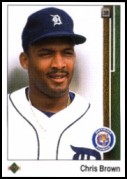
Today’s Tiger: Chris Brown

Chris Brown

  • Born: Aug. 15, 1961 in Jackson, Miss.
  • Died: Dec. 26, 2006 in Houston
  • Acquired: Traded by the Padres with Keith Moreland to the Tigers for Walt Terrell on Oct. 28, 1988.
  • Seasons in Detroit: 1 (1989)
  • Bats: Right Throws: Right
  • Height: 6′ Weight: 185 lb.
  • Uniform Number: 35
  • Stats: .193 avg., 0 HR, 4 RBI, .449 OPS

Perhaps no other word best describes third baseman Chris Brown like enigmatic.

After a promising start to his career with the Giants in 1985, his .271 average and 16 homers earned him a fourth-place finish in the National League Rookie of the Year Award, and an All-Star Game appearance in ’86, Brown began frustrating his managers and his teammates with a string of questionable and bizarre injuries. In fact, he never appeared in more games than he did that rookie season (131).

By the middle of the 1987 season Brown was shipped to the Padres with Keith Comstock, Mark Davis and Mark Grant for Dave Dravecky, Craig Lefferts and Kevin Mitchell. He didn’t fare well in San Diego either, hitting .232 in 44 games. In 1988 he hit just .235 in 80 games.

The Tigers were in complete freefall when they traded Walt Terrell to the Padres for Brown and Keith Moreland, whose best years were behind him. Why Detroit thought Brown and his “Tin Man” reputation would be transformed under Sparky Anderson is mystifying. His reputation for injuries — real or imagined — ranged from shoulder tenderness, a bad tooth and a sore eyelid. At least those are the more legendary ones — who knows if they were true.

In Detroit, the Chris Brown Experiment — such as it was — got off to a poor start when he arrived to spring training overweight. It ended after just 17 games, 11 hits and a .193 average. Worse yet, if possible, was a .909 fielding percentage in that time. On May 19, he was released. A few weeks later he was signed by the Pirates but never appeared in a big-league game for them.

He died in a mysterious Houston house fire on Dec. 26, 2006, at the age of 45. According to this MLB.com story:

Brown was employed by Halliburton Co. in Iraq, driving and repairing 18-wheel fuel trucks, and in a 2004 interview with The Associated Press, he said, “It’s a place I would’ve never thought 20 years ago that I’d be.”

His final career line: .269 average, 38 home runs, 184 RBI and a .725 OPS.

Today’s Tiger: Mickey Tettleton

Mickey Tettleton

  • Born: Sept. 16, 1960 in Oklahoma City
  • Height: 6′ 2″ Weight: 200 lb.
  • Acquired: Traded by the Orioles to the Tigers for Jeff Robinson on Jan. 11, 1991.
  • Seasons in Detroit: 4 (1991-94)
  • Uniform Number: 20
  • Stats: .249 avg., 112 HR, 333 RBI, .867 OPS
  • Awards: Silver Slugger (1991, ’92) All Star (1994)

Who didn’t like Mickey Tettleton? He was built like a tank, stood ramrod straight at the plate and could crush the ball from either side of the plate. And, he wasn’t half-bad behind the plate.

Mickey Tettleton.jpgTettleton came to Detroit in a steal of a trade from the Orioles 20 years ago next week, the Tigers sending once-promising righty Jeff Robinson to Baltimore in the deal.

After four nondescript seasons with the A’s in which he never hit more than 10 home runs, Tettleton was released by Oakland and signed by the Orioles at the end of March 1988. That season he hit 11 homers but struck out 117 times in 411 at bats.

In 1989, however, he became a dangerous hitter, clubbing 26 homers and earning an All-Star appearance. And while his strikeouts rose along with his plate appearances, so did his walks. In 1990, he fanned 160 times (a career high) but walked 106.

Why would the Orioles, who weren’t exactly brimming with offensive talent, want to part ways with Tettleton? According to this story, they “did not want to pay him more than $1 million to be backup to Bob Melvin.” Bob Melvin! And shortly thereafter his ticket to Detroit was punched.

“He has good defensive skills and is adept at working with pitchers,” acting Tigers General Manager Joe McDonald said. “In addition, he brings even more punch to our lineup.”

And how.

Continue reading “Today’s Tiger: Mickey Tettleton”

A New Project for 2011: “Today’s Tiger”

Today I’m launching a project that I’ve wanted to explore since I started The Daily Fungo in March 2006. I’m calling it Today’s Tiger, a daily look at a Tigers player from the past, posted each day of 2011. Some installments will be brief, others more in-depth but hopefully you’ll learn a little bit about Tigers history and the players that’ve worn Olde English D.

Let me know what you think — and feel free to suggest players you’d like me to highlight.

So, with that, here’s the first installment.

Lynn Jones

  • Born: Jan. 1, 1953 in Meadville, PA
  • Acquired: Drafted from the Reds in the 1978 rule 5 draft, Dec. 4, 1978.
  • Seasons in Detroit: 5 (1979-83)
  • Uniform number: 35 
  • Stats: .264 avg., 6 HR, 71 RBI, .658 OPS

LynnJones.jpg
The Tigers selected Lynn Jones from the Reds in the December 1978 Rule 5 Draft and, as they were required to do, kept him on the 25-man roster the entire 1979 season. In 95 games that year Jones batted .296 with four home runs, seeing time mostly in the outfield but also as a pinch-hitter.

Jones was a role player and pinch hitter for Sparky Anderson’s earliest Detroit teams, posting a decent on-base percentage in his first three seasons. The 1982 and ’83 seasons, though, saw his production slip and as a result his playing time was limited to 64 at bats in ’83.

That offseason the Tigers made him a free agent and he promptly signed with the Royals. In 1984, Jones hit a career-high .301 in a similar role to what he played in Detroit. He faced his former team in the American League Championship Series, going just 1 for 5.

The next season Jones appeared in 110 games for Dick Howser‘s Royals — a career high — but saw his average plummet 90 points. It wasn’t a total downer though, he won a World Series ring that year and had two extra-base hits in the Series against the Cardinals.

1986 would be his final big-league season — and his worst statistically. He hit .128 in 67 games with a single RBI and after that season he became a free agent but didn’t sign with another team.

Jones was the Royals’ first base coach in 1991 and 1992 before managing in the Marlins system. In 2001, he was the Marlins’ first-base coach. He earned his second World Series ring in 2004 as a member of Terry Francona‘s coaching staff in Boston. Today he’s the Braves’ baserunning coordinator.

2010: The Year in Lists

A year ago, we were still stinging from Game 163 and not certain how the Tigers would respond to a crushing end to the 2009 season. Would they regress to 2008’s disappointment or regroup to erase the memory of the ’09 collapse?

The answer was: they’d be relevant. And that, ladies in gentlemen, is the extent of the analysis in this post. Instead of a deep dive into 2010, let’s look at the year in the form of randomly selected lists:

2010 At A Glance*

  • Record: 81-81, 3rd in American League Central, 13 games back of Minnesota
  • Days in First: 13, the last on July 10
  • Biggest Lead: 1, last on July 7
  • Farthest Behind: 15.5 on Sept. 15
  • Most Games over .500: 11, last on July 10
  • Most Games under .500: 5, last on Aug. 19
  • Longest Winning Streak: 7, June 11-18
  • Longest Losing Streak: 7, July 11-20
  • Most Runs Allowed: 15, June 9
  • Most Runs Scored: 13, Aug. 15
  • Longest Game (innings): 14, July 19
  • Times Shutout by Opponent: 10
  • Times Opponent Shutout: 5

Continue reading “2010: The Year in Lists”