The first time my brother imitated the finger-waving batting stance of a Tigers player by the name of “Wockenfuss” I was convinced he made it up.
Not only did the name sound like a cartoon character, the flapping of the right hand on the bat was too much for my nine-year-old brain to process as a viable approach at the plate.
I soon learned that Johnny Bilton Wockenfuss was – and is – a real-life person.
Never a superstar, he was a Super Sub before the phrase existed. He played key roles for the Tigers and helped the club bridge the gap between emerging contender and World Series Champion.
‘Fuss was drafted by the Washington Senators in the 42nd round of the 1967 amateur draft. His road to Detroit wound through Arlington, Texas, after the Senators relocated following the 1971 season.
On June 6, 1973 he was traded by the Rangers with Mike Nagy to the Cardinals for Jim Bibby. Less than six months later – on Dec. 3 – St. Louis sent him to the Tigers for minor-leaguer Larry Elliott.
Ironically, Wockenfuss made his major league debut on Aug. 11, 1974 against the Rangers at Arlington Stadium – and faced the pitcher he was traded for a year earlier, Bibby.
He started at catcher, as he would 12 more times that season, and, batting ninth, went 0 for 2 with a walk. In his first big-league at bat (leading off the Tigers third) he popped out to shortstop Toby Harrah.
Wockenfuss’s first major league hit would come three days later at Tiger Stadium off Royals starter Steve Busby — an RBI single with two outs in the ninth (Jim Nettles, brother of Graig scored).
During the lean years of the mid-1970s, Johnny B. – wearing first #45 and then, from 1976 on, #14 – steadily gained playing time, primarily behind the plate for manager Ralph Houk. When Sparky Anderson was hired in 1979, ‘Fuss became more of a first baseman/outfielder/DH hybrid.
For the next four seasons, Wockenfuss had a .265 average. His best year at the plate for Detroit was in 1982 when hit batted .301 in 79 games.
In the spring of 1984, the buzz around Lakeland was of a team poised to make the leap to the postseason. Wockenfuss had been so valuable to the Tigers over his 10 seasons that no one suspected he wouldn’t be with Detroit on Opening Day.
But on March 24, 1984, roughly one week before the Tigers opened the season in Minnesota, ‘Fuss was traded with outfielder Glenn Wilson to the Phillies for Willie Hernandez and Dave Bergman.
We know how that played out.
In Philadelphia that year, Wockenfuss played in 86 games, mostly at first base, batting .289. In 1985, he appeared in just 32 games, collecting six hits. When the Phillies released him on Aug. 19, 1985 – almost 11 years to the day of his debut – his career was over.
Two years later, though, he was back in the Tigers organization as the manager of Lakeland in the Florida State League. He appeared to be on a meteoric rise in the organization. In 1988 he led the Glens Falls Tigers of the Eastern League two a first-place finish. The next season he was promoted to manager of Toledo where the Mud Hens finished in sixth place. He lasted only 24 games of the 1990 season before he was fired on April 29.
And that was all she wrote for Johnny B. Wockenfuss as a member of the Tigers family.
I remember feeling bad in 1984 that Johnny B. wasn’t around to enjoy the Tigers World Series championship. Years later when the Pistons won their first NBA Title they had some of the old guard on hand for the celebration. Too bad Wockenfuss couldn’t have participated in a similar sort of revelry in October ’84.
Raise a glass today for Johnny B. Wockenfuss. He’s 59.

 Yesterday was Johnny Grubb‘s 60th birthday. Yes, 60th. I recently had the pleasure of talking with him while doing research for SABR’s book on the 1984 Tigers. (I’ve written the biographies of both Grubb and outfielder Rusty Kuntz.) We spoke about his entire career and focused a lot, of course, on the ’84 team.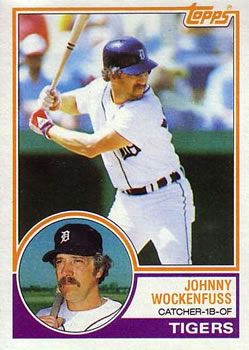
 dailyfungoarchive.com