Tigers Wild Ride in ALCS Continues

And this evening I gleefully eat crow.

Justin Verlander or no, I didn’t expect the Tigers to win Game 5. After Wednesday night’s deflating extra-inning loss, my typically optimistic self thought the Tigers had run out of gas and that the Rangers were just too hot to lose.

Texas was making the most of their opportunities — lord knows they (and the Tigers with much less success) have had plenty this series — and how long could Detroit’s worn out pitching staff keep Michael Young and Adrian Beltre, the only Rangers not scorching the ball these days, in check? Not long, at least in the case of the former.

When Young doubled in the first inning, that queasy feeling of doom washed over me. Then I got angry: No way Verlander wilts in this situation. He didn’t.

Despite what some wrote, Verlander was terrific. Untouchable? No. But he had enough stuff, grit and determination to get the outs he needed at just the right time.

These same observers are saying the Tigers were lucky to win this game. Well, yeah — and it’s about time a bounce went Detroit’s way. And an ice-cold hitter hit a home run. And a starter went deep into the game. And someone other than Joaquin Benoit and Jose Valverde got the final outs. And a packed Comerica Park trembled one more time.

If the Tigers go on to win this series, imagine how we’ll remember a beaten down Alex Avila at last delivering a key hit with an opposite field home run, or how iconic Miguel Cabrera‘s sixth-inning double off the third-base bag will become in Detroit sports lore. Or Victor Martinez‘s triple when the man can hardly walk. Or Delmon Young‘s two rockets to left-center that put him in elite company in the Tigers’ postseason record book.

With Max Scherzer going in Game 6 — the first time the Tigers have been in a postseason Game 6 since 1968 — you have to feel good, don’t you? My guess is that he feels he has some unfinished business after Game 2 and will be on a mission Saturday night.

For now though, I’m going to savor this win and the crow I was forced to eat after not so much doubting the Tigers’ grit, but recognizing the offensive buzz saw that’s the Texas Rangers right now.

And you know what? Jim Leyland seems to be having the time of his life in this series. Perhaps it’s time I stop fretting every pitch and just enjoy the ride too.

Who’s with me?

The End of Denny McLain’s Career Began in 1966

A couple weeks ago, friend of the Fungo Lynn Henning wrote why it made sense to give Justin Verlander an extra day of rest heading into the three-game weekend series against the Indians.

In the column, Henning pointed to specific examples in Tigers history where heavy workloads resulted in truncated careers – among them Mark Fidrych.

Here’s the gist:

[L]et’s talk about some past Tigers history that might help put the Verlander decision in better perspective.

(snip)

Denny McLain won 31 games in 1968 — the only man in the past 77 years to have done so — and 24 the following season.

He won two Cy Young Awards during those two seasons. He won Most Valuable Player in 1968.

He pitched a combined 661 innings — no misprint — during those two campaigns.

He was 25 years old at the end of the ’69 season.

He won 21 games, total, the remainder of his career. His arm had been fried during those two colossal seasons.

I knew pitchers 40 years ago regularly went deep in games and threw a lot of pitches, but McLain’s output in 1966 was staggering.

On Aug. 29, 1966, McLain threw 229 pitches in the Tigers’ 6-3 win over the Orioles. He gave up eight hits, walks nine and struck out 11 Orioles to notch his 16th win. According to the Baseball Reference.com box score, McLain faced 43 batters in the game.

He was just 22 at the time.

In that game, McLain set the Orioles down in order only one time, the bottom of the second. In every other inning he faced, on average, about five hitters per inning.

Did I mention he was only 22?

Three days later, on Sept. 1, McLain faced the Indians in Cleveland and again went the distance, facing 39 batters. He retired the side 1-2-3 twice in the game but otherwise had a similar pattern to his previous start. (The Tigers won, 4-2.)

[callout title= McLain By the Numbers]

13-4 – McLain’s record in the first half of 1966

7-10 – His record in the second half

.214 – Opponents’ batting average against (lefties hit just .199 off him in ’66)

21 – The number of starts McLain made (out of 38) on three-days rest

1.13 – His ERA in the one start he had on two-days rest (one ER over eight innings)

6.16 – His ERA in the first inning

2.52 – His ERA in the ninth inning

8 – The number of starts to begin the season in which McLain pitched seven or more innings

[/callout]

On Sept. 6, McLain pitched nine innings, allowed 11 hits, two runs and struck out six, in an 8-2 win over Washington at Tiger Stadium. He faced 38 Senators hitters in this game, his 18th win.

McLain’s 1966 campaign concluded with him making three starts in the span of eight days. On Sept. 23, he didn’t make it out of the third inning, surrendering eight earned runs on seven hits.

Three days later he went eight innings, allowed one run on four hits against 30 Angels batters on the way to his 20th win.

On Oct. 1, the next-to-last day of the season, McLain would pitch 3 2/3 innings, allowing four earned runs on seven hits. He took the loss, his 14th, 5-2 to the A’s.

Fourteen and a third innings in three days. Totals like that can certainly make it a bit easier to appreciate today’s pitch-count obsessed mindset in baseball.

All told, McLain threw 264 1/3 innings in 1966. Forty years later, a 23-year-old Verlander threw a comparatively meager 186 innings – and there was talk then that he was approaching overworked status.

There’s no chance the Tigers would put such a ridiculous workload on Verlander – or, in a more apt comparison, Rick Porcello, and Lynn Henning’s column makes a good case for why pitch counts matter, even though I admittedly roll my eyes when I hear them mentioned during games.

And a closer look at a season from 45 years ago explains Denny McLain’s precipitous fall from a 31-game winner at the age of 24 to the loser of 22 games three years later, and his departure from baseball when he should have been entering his prime.

An Older, Wiser Verlander Spins an Even More Impressive No-Hitter This Time

VerlanderHeadI got the first inkling of what was happening at Rogers Centre this afternoon courtesy of the Blue Jays’ radio crew via SiriusXM Radio. A short time later I was home in time for the sixth inning, watching as Mario and Rod tiptoed around the then-perfect game in progress.

As I watched Justin Verlander dominate the Jays en route to his second career no-hitter, I was struck by how different this one was compared to the gem he threw on June 12, 2007 against the Brewers.

Four years ago, Verlander was fresh off his Rookie of the Year season and had the cockiness of a young stud and was determined to blow away every Milwaukee hitter.

He threw 112 pitches, faced 30 hitters, fanned a dozen and walked four. This game was at home and he was clearly riding the adrenaline rush. He was throwing that night — and doing so with gusto.

Today was an exercise in pitching and, well, the only word that jumps to mind is “maturity.” Facing the minimum 27 batters, Verlander threw 108 pitches and struck out just four. But he seemed, I don’t know, focused and like he’s been there before.

Of course, this is the new brand of Verlander that we’ve heard about all season: more serious about his craft, more focused on game days, and so on.

I’ve been critical of Verlander in the past — specifically because of his desire to be the Tigers’ ace but not acting like it often enough.

After his crisp dismantling of the Blue Jays, he has taken a big step toward cementing himself in Tigers history as one of the franchises best of all time.

And, I think he did it by simply growing up.

Tigers’ 2011 X Factor: Phil Coke

In Phil Coke’s three-year major-league career, he’s finished 31 games and he’s started just one — the Tigers’ final game of the 2010 season. That outing could best be described as abbreviated; he threw 1.2 innings, allowing five hits, a walk and two runs.

What conclusions can we draw from this micro-sample size? Less than nothing.

That’s part of the reason Tigers fans are interested to see how Coke performs in 2011 now that he’s a member of the rotation, slotted neatly behind Justin Verlander and Max Scherzer. That’s not to say Coke has no experience as a starter. Quite the opposite, in fact.

Coming up through the Yankees’ system in the mid-2000s, he worked predominately as a starter. From 2005-08, Coke started 77 games.

At Double-A Trenton in 2008, he started 20 games and posted a 2.51 ERA to go with his 9-4 record. That earned him a call-up to Triple-A Scranton/Wilkes-Barre where he was turned into a reliever.

Go figure.

Year Age Team Lg Lev W L W-L% ERA G GS CG IP
2005 22 Charleston SALL A 8 11 .421 5.42 24 18 0 103.0
2006 23 2 Teams 2 Lgs A+-A 5 8 .385 3.19 27 20 1 127.0
2006 23 Charleston SALL A 0 1 .000 0.53 5 2 0 17.0
2006 23 Tampa FLOR A+ 5 7 .417 3.60 22 18 1 110.0
2007 24 Tampa FLOR A+ 7 3 .700 3.09 17 16 1 99.0
2008 25 2 Teams 2 Lgs AA-AAA 11 6 .647 2.79 37 21 1 135.2
2008 25 Trenton EL AA 9 4 .692 2.51 23 20 1 118.1
2008 25 Scranton/Wilkes-Barre IL AAA 2 2 .500 4.67 14 1 0 17.1
6 Seasons 31 29 .517 3.61 125 77 3 496.0
Provided by Baseball-Reference.com: View Original Table | Generated 3/28/2011.


With his return to the rotation this spring, Coke posted a 3-2 record with a 2.49 ERA in 21.2 innings. Not shabby, but how will it play out over the long season? Lynn Henning today provided this assessment of Coke:

He looked good for much of the spring, but took some knocks late. The switch to starting is still in progress. If things don’t work out, he goes back to the bullpen, Andy Oliver moves in, and the Tigers probably strengthen their seventh-inning options. But they’ll give this experiment a full and necessary opportunity to work.

We’ll have to see what “a full and necessary opportunity” means. If Coke lasts as a starter, what’s the impact on the bullpen? Or, does it mean he’s more valuable in relief compared to the young arms the Tigers can summon to the rotation, such as Andy Oliver and/or Jacob Turner?

And it all hinges on Phil Coke. What do you think?

Game 162: Vintage Verlander

ESPN highlights available here.
ScorecardXSmall.jpg

The Score: Tigers 5 – White Sox 3

The Gist: You couldn’t ask for more than Justin Verlander delivered on Sunday afternoon in the Tigers’ home finale of the as-yet-undecided 2009 season. Ryan Raburn went yard twice and the resurrected Magglio Ordonez went 4 for 4 to power most of the offense. Of course, it wouldn’t be a Tigers game without a wasted inning with a starter, this time John Danks, on the ropes. A win is a win, though this win would’ve been better on, say, Thursday.

The Quote: “I wasn’t sure right away I was going to get there.” Curtis Granderson, referring to either his diving catch in the eighth which saved the game from looming disaster OR the Tuesday playoff game in Minnesota.

The Stat: 12 and 13 – The Tigers’ record this year on Tuesdays

Magic Digit: 1

Up Next: Tigers @ Twins – Tuesday, 5 p.m. ET on TBS

Rick Porcello (14-9. 4.04 ERA) vs. Scott Baker (15-9, 4.36)

Follow The Daily Fungo on Twitter: @DailyFungo

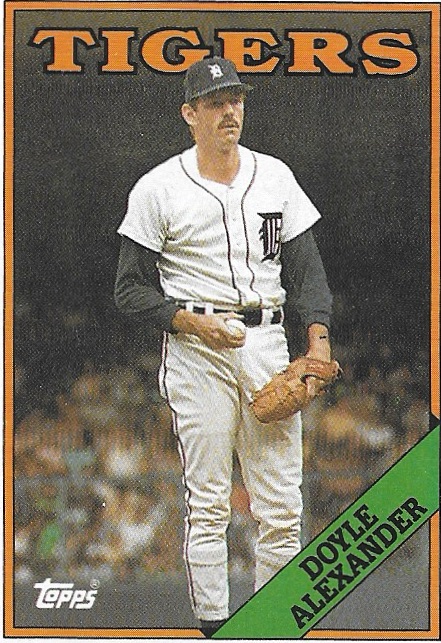
Looking Back on Doyle Alexander’s 1987 Shutout at Fenway Park

Dan Dickerson was quick to point out that Justin Verlander’s shutout on Thursday was the first by a Tigers pitcher at Fenway Park since Doyle Alexander blanked the Red Sox in 1987. (Thanks to a tip from Fungo contributor Doug Hill, we went scrambling for the details.)

The Tigers were a half-game out of first place on Sept. 23, 1987, for the finale of a three-game series against Boston.

Alexander, who blanked the Red Sox a week earlier, 3-0 at Tiger Stadium, faced off with lefty Bruce Hurst and was untouchable.

He allowed singles to the first two batters he faced, Ellis Burks and Marty Barrett, and a two-out walk to Spike Owen in the second and that was it.

Alexander got two runs in the second and one each in the fifth and sixth. Tom Brookens drove in a pair and Alan Trammell knocked home one in the win. (The fourth run was scored on an error.) The Tigers moved on to Toronto for a grueling four-game series for ages against the Blue Jays.

You’ve got to love Baseball-Reference.com; I know I sure do.

2009 Player Profile: Justin Verlander

This is the first in a series of player profiles of the 2009 Tigers. I’ve developed them for each of the position players and the starting rotation — at least some of the pitchers in contention for a rotation spot — and will roll them out over the next week.

We kick things off with birthday boy Justin Verlander who turns 26 today.

Justin Verlander #35

  • Height: 6′ 5″ | Weight: 200
  • 2008 Stats: 11-17, 4.84 ERA

VerlanderHead.jpgWhen a number-one starter opens the season 2-9, chances are his team faces a severe uphill climb. That certainly was Justin Verlander’s reality in 2008. When the calendar turned from April to May, the Tigers’ ace had a 1-4 record with a 6.60 ERA, and by Memorial Day he was 2-9. But as the Tigers offense started to click in June, so did Verlander.

In nine starts from June 6 through July 20, he went 7-2 including a six-game winning streak. His ERA in June alone was 2.73 as hitters produced a mere .197 average against him. Ultimately the problem for Verlander in 2008 – and the Tigers’ entire staff – was walks. In 33 starts he issued 20 more free passes and fanned 20 fewer men than he did in ’07, fueling a 11-17 record and a 4.84 ERA.

Looking ahead to 2009, the Tigers and new pitching coach Rick Knapp will expect Verlander to have greater command of his explosive stuff and regain the dominant form of 2006 and ’07. Watch for Verlander to reclaim the inner part of the plate in ’09, and use a near-triple-digit fastball and devastating breaking pitches to remind A.L. hitters that he’s one baseball’s elite starting pitchers.

The Top 10 Tigers Stories of 2008: #2 – The Pitching. Oh, the Pitching.

Number2.jpgIf we had to narrow the Tigers’ dismal 2008 to one culprit it would be the pitching. While Detroit’s offense had many fits and starts throughout the season, the pitching was pretty much the same from March 31 to Sept. 28: awful.

Whether it was Dontrelle Willis‘ sudden inability to throw strikes or Justin Verlander‘s season of wild inconsistency or merely the bullpen’s tendency to do just about everything wrong, the pitching was Public Enemy No. 1 at Comerica Park and 13 other American League parks (not to mention parks across the N.L. West).

One final look at the Tigers pitching woes:

  • Team ERA: 4.91 — 12th in A.L.; 27th in MLB
  • Strikeouts: 991 — 11th / 25th
  • Walks: 644 — 13th / 27th
  • Blown Saves: 26

Oh, what the hay, let’s take a quick look at how the rotation fared:

  • Verlander: 11-17, 4.84 ERA, one (and the Tigers’ only) complete game
  • Armando Galarraga: 13-7, 3.73
  • Kenny Rogers: 9-13, 5.70
  • Nate Robertson: 7-11, 6.35
  • Jeremy Bonderman: 3-4, 4.29
  • Willis: 0-2, 9.38

Yep. Ugly.

But thankfully the 2008 season — and soon this list — is over and done with.