The Friday Fungo

Fernando Valenzuela?

Yes. Briefly.

This blog could not exist without Baseball Reference, and the $80 a year for the ad-free subscription is a steal given how much time I spend on the site. I always seem to uncover some delightful tidbit and lately it seems to be the result of post-Immaculate Grid curiosity.

Today’s discovery might be atop the list, if I kept a list.

Did we know Fernando Valenzuela was, for 75 days, in the Tigers system?

This development leads to a less-intriguing but worthy follow-up question: Did we know Rick Renteria was too?

My answer, at least, is: no!

Random Game: Aug. 13, 1983

Tigers 6 – Yankees 3

W: Jack Morris (14-8) – L: Ron Guidry (13-8) | Boxscore

  • I sat in the upper-deck bleachers, dead center, for this game with my brother, future brother in law, and my friends (to this day!) Rob and Jeff.

  • It could not have been a better stage: A warm August Saturday night, a packed house to see Jack Morris face Ron Guidry in a classic 1980s A.L. East showdown with the teams tied for the division lead.

  • This was the first time in my Tigers fandom that the Tigers were this good, this close to first place, this late in the season — not counting 1981.

  • The game took place a few days after Yankees right fielder Dave Winfield had dispatched a seagull with a warmup toss at Toronto’s Exhibition Stadium. Those of us in the bleachers tormented him with bird-like arm waving. Top-notch hijinks for a 15 year old.

  • We went crazy after the game when the scoreboard showed the standings with the Tigers on top by a game. Insanity.

Highlights

  • The Yankees led 3-2 until the bottom of the seventh when John Wockenfuss launched a homer to left, scoring Larry Herndon, to take a 4-2 lead. (I can still it in my mind, the ball arching in slow motion to left … but now I can’t remember if it was upper or lower deck.)

  • Glenn Wilson hit a two-run double in the eighth to widen the lead to 6-2.

  • Alan Trammell went 4 for 4.

  • Morris went the distance, scattering six hits and striking out 12.

  • According to The New York Times game story by Murray Chass, the loss snapped Guidry’s seven-game Tiger Stadium winning streak. The Tigers had last beaten him in Detroit May 21, 1979, 3-1.

Miscellany

  • Umpires: HP – Al Clark, 1B – Bill Kunkel, 2B – Richard Shulock, 3B – Derryl Cousins.
  • Time of Game: 2:27
  • Attendance: 50,016
  • Start Time Weather: 76° F

Birthdays

José Valdez, Joe Mantiply, Jimmy Hurst, Doug Creek, Kris Keller and the late Tim Thompson

Today’s Grid

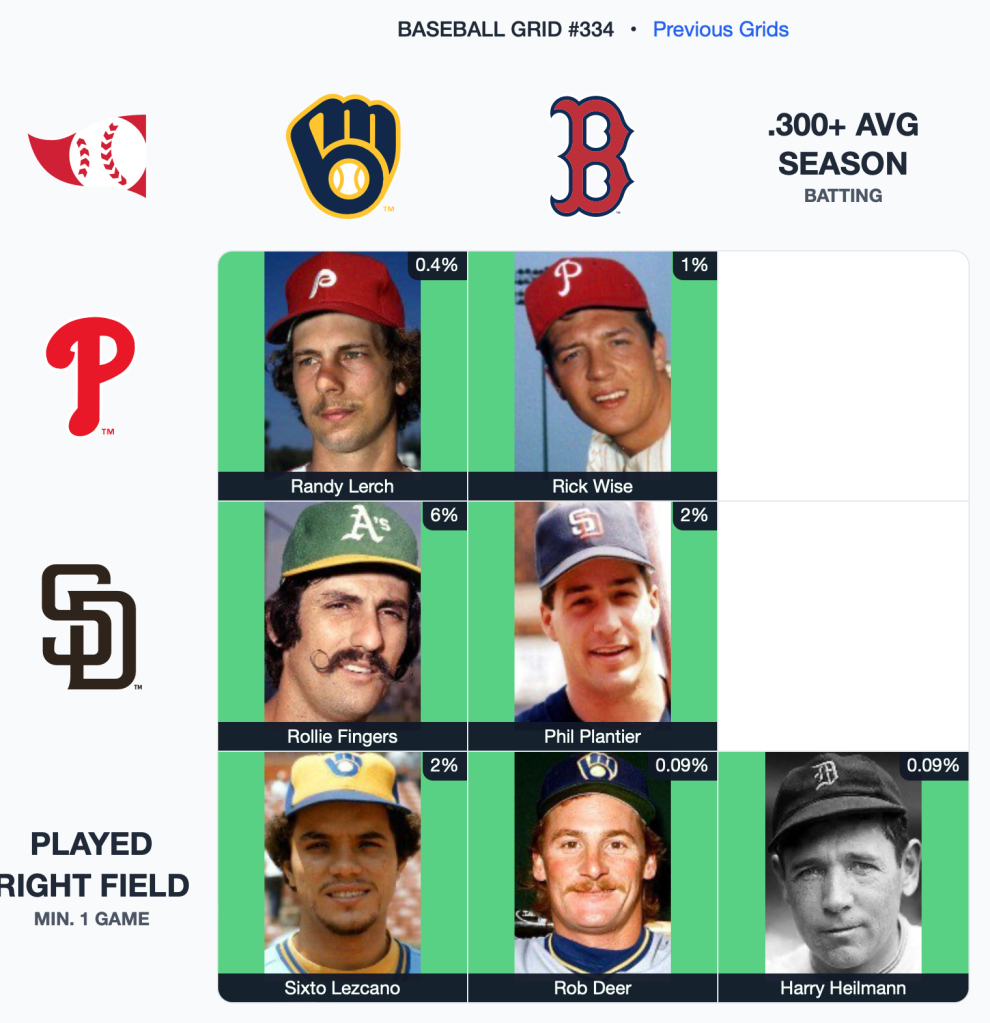
⚾️ Immaculate Grid 334 7/9 — Rarity: 212

Swings and misses include: Jerry Morales and Scott Rolen. But a couple of former Tigers*.

*Phil Plantier, in a classic Randy Smith move, was dealt away before he ever appeared in a regular season game for the Tigers.

Have a great weekend. We’ll see you tomorrow.

The Wednesday Fungo

Enos Cabell

The Tigers acquired Enos Cabell on March 4, 1982, in trade with the Giants for Champ Summers.

In 2011, Tom Gage wrote a piece in The Detroit News about Cabell (the original link to the article is here, but it’s not active for whatever reason) and I was interested to read why Cabell, who hit .311 for the 1983 Tigers, moved on after that season:

He wanted to stay a Tiger, and they weren’t averse to him staying.

“But they wouldn’t give me a raise,” Cabell said Saturday. “I hit .311, played with a knee brace the last two months of that year, and they wouldn’t give me a penny more.

“So I said bye-bye. I was pretty sure the Astros wanted me back, anyway.”

He filed for free agency on Nov. 7, 1983 and I couldn’t believe they let him walk away, especially after a solid ’83 campaign.

Six weeks later, on Dec. 17, 1983, the Tigers signed left-handed hitting Darrell Evans, a much-bigger power threat than the right-handed Cabell.

Then, of course, in March came the trade that defined the 1984 season: Willie Hernandez and Dave Bergman for Glenn Wilson and John Wockenfuss.

Who knows how that would have come about if they had re-signed Cabell? A few years later this news broke — and on this date in 1986 — and you have to wonder if this played into the Tigers thinking in the fall of ‘83.

Commissioner Peter Ueberroth gives seven players who were admitted drug users a choice of a year’s suspension without pay or heavy fines and career-long drug testing, along with 100 hours of drug-related community service. Joaquín Andújar, Dale Berra, Enos Cabell, Keith Hernandez, Jeffrey Leonard, Dave Parker, and Lonnie Smith will be fined ten percent of their annual salaries to drug abuse programs. The commissioner also doles out lesser penalties to 14 other players for their use of drugs.

Cabell’s career numbers in Detroit: .284 average, 7 homers, 83 RBI, .682 OPS.

Birthdays

Niko Goodrum, Chad Bell and the late Ron Samford and Lil Stoner

Today’s Grid

⚾️ Immaculate Grid 332 9/9 — Rarity: 9

I’m particularly proud of this one!

See you tomorrow.

The Friday Fungo: Feb. 9

On TV: Pat Underwood’s Debut, May 31, 1979

Today is Pat Underwood‘s 67th birthday. He was one of my favorite players during the early years of my Tigers fandom. Here’s a rebroadcast of his major-league debut, against his brother Tom, on May 31, 1979.

Check out this excellent bio of Underwood written by Todd McDorman as part of the SABR Bio Project.

Birthdays

John Young, Vic Wertz, Don Hankins

Today’s Grid

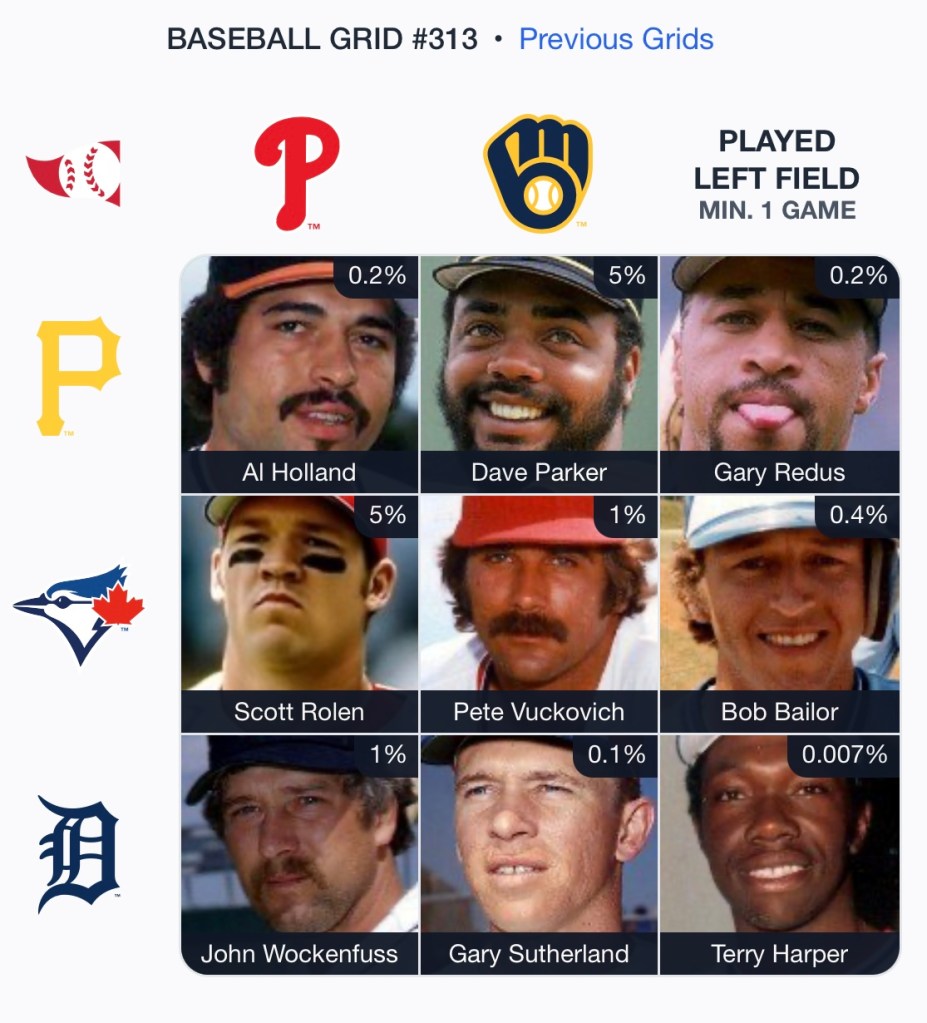
⚾️ Immaculate Grid 313 9/9: Rarity: 13

I also almost went with Lance Parrish instead of Scott Rolen but I wasn’t 100% confident Lance appeared in a game for the Jays. So, after completing the one below, I started a new grid and swapped out Lance for Rolen — 5% for Rolen v.s. 0.4% for Lance. I put in all the other picks from below and it dropped my Rarity from 13 to 9! Should have gone with my instincts.

Screenshot

Have a great weekend. See you tomorrow.

The Trade, 25 Years Later

Want to feel old? Try this on for size:

It was a quarter-century ago — March 24, 1984 — that the Tigers acquired relief pitcher Willie Hernandez and first baseman Dave Bergman from the Philadelphia Phillies for catcher John Wockenfuss and outfielder Glenn Wilson.

And the insanity that was the Summer of ’84 began.

In case you’ve forgotten, Hernandez won the American League MVP and Cy Young awards after saving 32 games with an 1.92 ERA and 140.1 innings in 80 pitching appearances.

Good times.

Talking with Johnny Grubb – Part I

GrubbSteaks.jpgYesterday was Johnny Grubb‘s 60th birthday. Yes, 60th. I recently had the pleasure of talking with him while doing research for SABR’s book on the 1984 Tigers. (I’ve written the biographies of both Grubb and outfielder Rusty Kuntz.) We spoke about his entire career and focused a lot, of course, on the ’84 team.

In honor of Johnny Grubb’s birthday, here’s the first of two installments of the discussion. Beginning with the trade that brought him to the Tigers from the Rangers for reliever Dave Tobik.


Mike McClary: What was your mindset coming to Detroit in 1983?

Johnny Grubb: Well, [Rangers manager] Doug Rader called me in his office in spring training when I was with Texas and he told me that they had made a trade.

He used to call me Grubsteaks. He said, ‘Grubsteaks, you’re going to like where you’re going.’ I said, ‘where’s that?’ And he said, ‘Detroit.’

And, of course, if you get traded, that would be a good team to go to because we knew they were strong and getting better each year and right on the verge of being a real, real good ball club. So I was happy to go there.

MMc: Did you know anything about the team in terms of who your new teammates were going to be or Sparky’s reputation?

JG: I knew Sparky’s reputation as a manager from playing against him in the National League. And then, of course, they did have a boy on the team, Mike Ivie, that goes back to when I played minor league ball. He was a teammate of mine, and he was a player with Detroit then. So I was going into a ball club there that at least I knew one guy real well.

Continue reading “Talking with Johnny Grubb – Part I”

The 1984 Hernandez/Bergman Trade Revisited

In case you’d forgotten, it was 24 years ago this week that the Tigers swung a deal with the Phillies that changed the 1984 season for the Tigers dramatically — and instantly.

On March 27, 1984, the Tigers acquired lefty reliever Willie Hernandez and first baseman Dave Bergman from Philadelphia in exchange for OF Glenn Wilson (my favorite Tiger back then) and all-purpose guy John Wockenfuss.

With World Series expectations higher than perhaps ever in Tigers history and the team searching, as it was in 1984, for bullpen reinforcements, let’s look back on a trade for the ages.


Willie

There was no reason to expect the moon from Willie Hernandez as the Tigers’ new closer. After his trade to the Phillies from the Cubs on May 22, 1983, he went 8-4 with a 3.29 ERA and seven saves in 63 appearances, primarily as a setup man for closer Al Holland.

But, as if I need to remind you, in 1984 Hernandez put together the career year to end career years: 9-3, 32 saves, 1.92 ERA, 80 appearances, 140 IP, All Star, American League Cy Young Award winner and Most Valuable Player.

Sparky had lots to say about Willie Hernandez in his book about the ’84 season, Bless You Boys. Here’s some of it:

I’ve been in baseball for 31 years, and there’s no way I can believe what I saw in Willie Hernandez this year.

Don’t ask me to explain Willie. How do you explain a miracle? Every time Willie had a chance for a save, Willie got it. Every time we desperately had to have a win, Willie was there. When I read that Hernandez didn’t pitch in 82 of the Tigers regular-season games in 1984, I find it hard to fathom. As a kid it seemed as if he pitched every day. And as Sparky said, when he did pitch, good things usually happened.

Thanks to his miracle season, Hernandez, who wore number 21, cashed-in on a big contract extension with the Tigers and, at age 29, appeared to be the closer for the long term.

In 1985, he turned in a decent year, though spoiled-rotten Tigers fans took to booing Hernandez regularly. He had an astonishing 18 decisions (8-10) even though he compiled stats that current Detroit fans would love to see from Todd Jones: 31 saves, 2.70 ERA.

From 1986 until his final year in Detroit in 1989, Hernandez’s save totals fell from 24 to 8 then bumped up to 10 and 15. Meanwhile his ERA headed north rapidly, topping out at 5.74 in ’89 — when the entire franchise bottomed out.

The Tigers released him on Dec. 20, 1989. He never appeared in another major-league game. All told, Willie Hernandez finished his Tigers career with a 36-31 record, 120 saves and a 3.44 ERA.


Bergie

Dave Bergman was traded twice on March 24, 1984. The first deal sent him from the Giants to the Phillies for Alejandro Sanchez. (Interestingly, almost a year later, the Tigers sent Roger Mason to San Francisco for Sanchez) The Phillies quickly spun-off Bergman to Detroit. Most thought he would replace Wockenfuss as a part-time first baseman and outfielder. In reality, he became a workhorse defensive replacement for newly acquired Darrell Evans at first base.

In 1984, Bergman made a quick impact with his glove and, as the season wore on, with some clutch, late-inning heroics.

In the bottom half of the eighth inning at Comiskey Park on April 7, Sparky put Bergman in at first base as a defensive replacement for Barbaro Garbey. The White Sox’ Jerry Hairston ripped a groundball down the first-base line. Bergman, playing close to the line, slid to his left and snuffed the grounder for the first out of the inning but more importantly, protected Jack Morris‘s no-hitter.

(Nearly a year earlier, Hairston crushed Milt Wilcox‘s bid for a perfect game with two outs in the bottom of the ninth. That’s what we call karma.)

On June 4 in Detroit against the Blue Jays, Bergman had what Sparky called the greatest at bat he’d seen in his life. Let’s allow Captain Hook describe it, again from the pages of Bless You Boys:

Here’s the scene: Two out in the last of the tenth, two men on, and the score tied at 3-3. Reliever Roy Lee Howell (sic) pitched to a full count. Then Bergie took over. Bergie fouled off seven pitches and then picked one practically off the ground and drilled it into the upper deck in right.What a battle! Bergie was up there a full seven minutes. It seemed like a whole season. The house went wild.

Actually, Bergman’s homer came off Roy Lee Jackson, which surprised me because I thought it was Luis Leal.

What made that game so much fun was that it was the season opener for ABC’s Monday Night Baseball, which was much bigger back then than ESPN’s Wednesday or Sunday night games are today. Also, school was almost out for summer and my friends and I were fired up for lots of excursions to Tiger Stadium’s bleachers.

During the 1984 season, Bergman appeared in 120 games, 114 at first base and one each in right and left field. He finished the year with a .273 average, seven home runs and 44 RBI. Defensively, Bergman made just eight errors in 732 chances, a .989 fielding percentage.

Wearing Wockenfuss’s number 14, Bergman became a mainstay with the Tigers. In nine seasons in Detroit he batted .252 with 39 home runs and 219 RBI. He retired after the 1992 season but remained in metro Detroit working in financial services.

Looking at the trade nearly a quarter century later, Detroit undoubtedly benefited the most. The Tigers got six seasons of work from Hernandez and nearly a decade from Bergman. Though the Phillies got barely a season and a half from Wockenfuss (whom we profiled here), Wilson had three respectable seasons in Philadelphia. In 1985, he batted .274 with 14 home runs and 102. The next season, he batted .271, 15 homers and 84 RBI.

Still, chances are only the most-diehard Phillies fan could point out any impression Wilson or Wockenfuss made on those mid-1980s Philadelphia teams. Tigers fans, however, remember vividly the contributions of Willie Hernandez and Dave Bergman.