The Saturday Fungo

My Top-5 Tigers

Lately I’ve been giving a lot of thought to who my all-time favorite Tigers are and who would make a tidy list.

Putting together my top 10 would be easy. Narrowing it to just five would be tough but I wanted to give it a shot.

What’s the criteria for this list?

I decided that this was my purely subjective list based on players I enjoyed watching play for the Tigers.

For example, Mark Fidrych doesn’t make the list simply because I never saw him play live — and I decided ESPN Classic and MLB Network reruns don’t count.

The legend of The Bird and his place in Tigers lore is secure for me.

Here’s my list* — not in order of favorite-ness, but in order of how they came to mind — which has been revised right up to the moment I clicked “Publish” on this post.

Honorable Mentions

*Always subject to revision.

Birthdays

None!

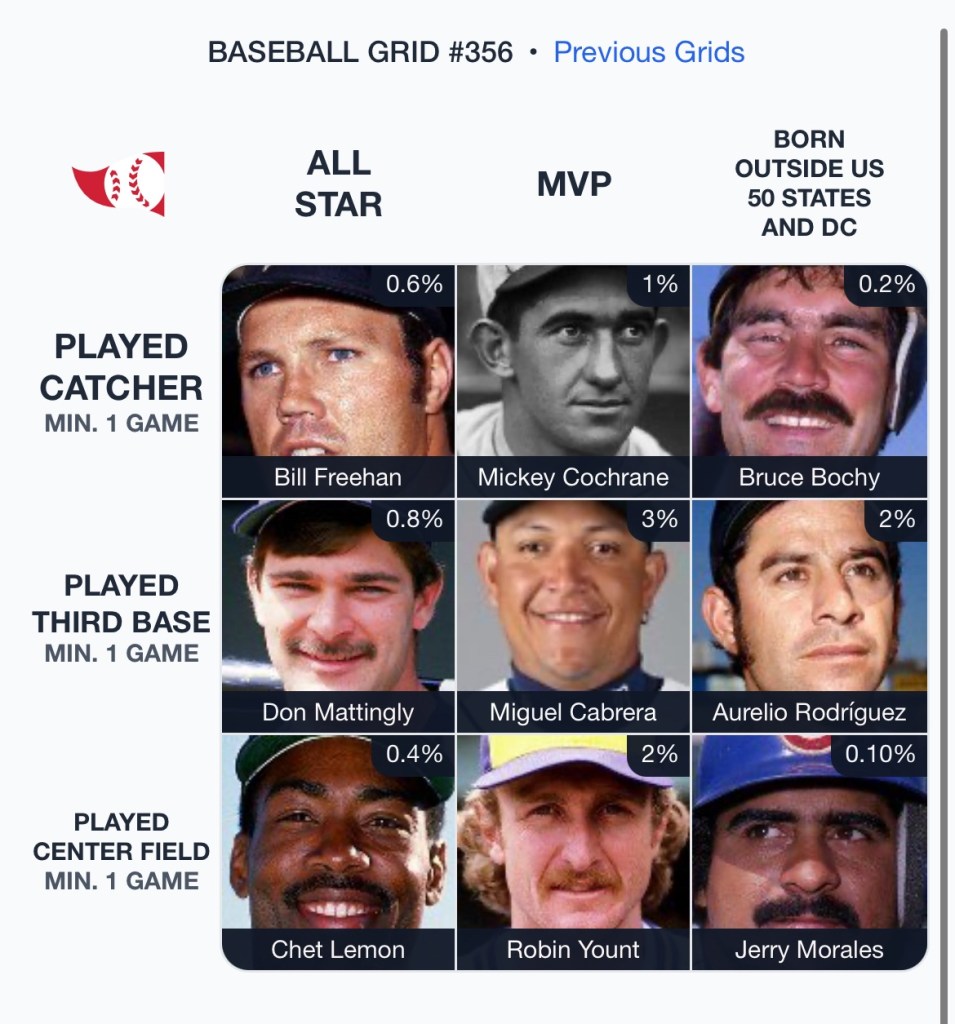
Today’s Grid

⚾️ Immaculate Grid 356 9/9 – Rarity: 11

See you tomorrow.

The Wednesday Fungo

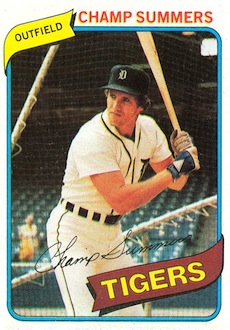
Champ Summers

Champ Summers was a fan favorite in Detroit and for good reason. He came to the Tigers as a career underachiever — at least at the major-league level — in an under-the-radar trade roughly a week before they hired Sparky Anderson in 1979.Summers_Champ

The Reds traded the 30-year-old Summers to the Tigers for a player to be named later on May 25, 1979. On Oct. 25, the Tigers sent Sheldon Burnside to the Reds to complete the trade.

The year before, John Junior Summers was the Minor League Player of the Year for the Reds’ top farm club, Indianapolis of the American Association. He led the AA with a .368 average, 34 homers and 124 RBI.

In 1979, Summers was hitting .200 with a single home run after 27 early-season games with the Reds, but after coming to Detroit, he had the best three seasons of his career.

That season he batted .313 with 20 home runs (14 solo) in 90 games and posted a .614 slugging percentage along with a 1.028 OPS. Anderson played Summers primarily in right field with a few DH assignments sprinkled in.

The Tigers rewarded him with a three-year contract near the end of the ’79 season.

Tigers fans loved Summers and he continued to provide punch to a young lineup. In 1980, his numbers slipped ever-so slightly but they were solid: .297/17/60 with an OPS of .897.

His production dropped further in the strike-shortened season of 1981 when, at age 35, his average fell to .255 and his power numbers plummeted, too. Summers hit only three home runs and eight doubles in 64 games in what would be his final season in Detroit.

In March 1982 the Tigers dealt him to the Giants for first baseman Enos Cabell. Summers would struggle in his two seasons in San Francisco, posting a .231 average and four home runs.

You can read the full post in the Archives.

Random Game: Aug. 7, 1987

Tigers 8 – Yankees 0

W: Jeff Robinson (8-5) – L: Rick Rhoden (14-7) | Boxscore

A classic midsummer showdown between A.L. East rivals, who were gridlocked atop the division heading into this game:

AL East Division July 17,1987
Tm W L W-L% GB
TOR 65 44 .596
NYY 65 45 .591 0.5
DET 62 44 .585 1.5
MIL 56 51 .523 8.0
BOS 51 57 .472 13.5
BAL 49 60 .450 16.0
CLE 40 69 .367 25.0
Provided by Baseball-Reference.com: View Original Table Generated 3/13/2024.
 
I was there for this one with a big group of friends in our usual bleacher seats, upper deck, dead center.

Miscellany

  • Umpires: HP – Mike Reilly, 1B – Tim Welke, 2B – Terry Cooney, 3B – Joe Brinkman
  • Time of Game: 2:31
  • Attendance: 48,262

Birthdays

Mike Aviles, the late Cliff Mapes, Eric Erickson and Mal Eason.

Today’s Grid

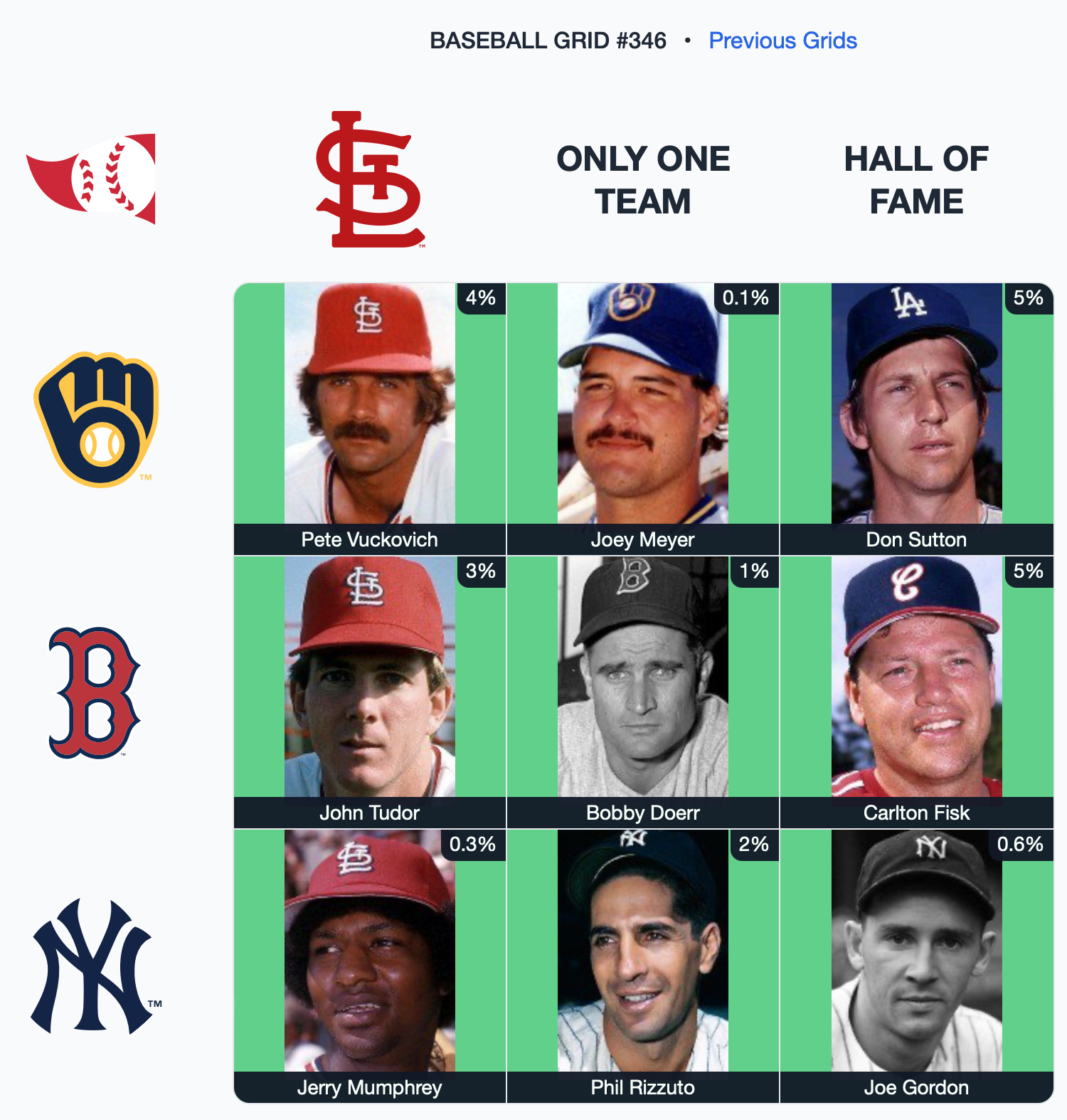
⚾️ Immaculate Grid 346 9/9 — Rarity: 22


Screenshot 2024-03-13 at 8.06.16 AM

See you tomorrow.

The Tuesday Fungo

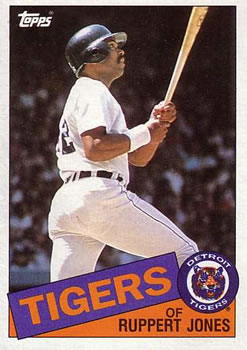
Ruppert Jones – #32

The 1984 season was an embarrassment of riches on so many levels. And when the Tigers signed Ruppert Jones to a minor-league deal on April 10, 1984, it was almost too much to comprehend.

Jones started the year in Evansville for what amounted to an extended spring training. That didn’t stop my friends and me from wondering:

When will he get called up?

Where will he play? 

When will he play?

  • The answer to the first question was early June, after lighting up the American Association, batting .313, 9 HR, 45 RBI and a .986 OPS in his 45 games with the Triplets.
  • The answer to the second question was left field and centerfield, with spot DH duty.
  • As for question three: 79 games. He finished the year with a .284 average, 12 HR, 37 RBI and a .862 OPS. 

In the postseason, Jones played in just four games — ALCS games one and two, and World Series games two and four — and notched only a walk and a run scored in nine plate appearances.

After the ’84 season, the Tigers let him walk — not a popular move in my eyes at the time (or now!). In January 1985, Jones signed with the Angels and played for them until his final big-league game, Oct. 4, 1987.

Check out this full bio on Jones by Adam Ulrey as part of SABR’s Bio Project.

Birthdays

Zach MinerCraig DingmanRuppert JonesLarry Rothschild and the late Eulogio “Frankie” De La Cruz and George Maisel

Today’s Grid

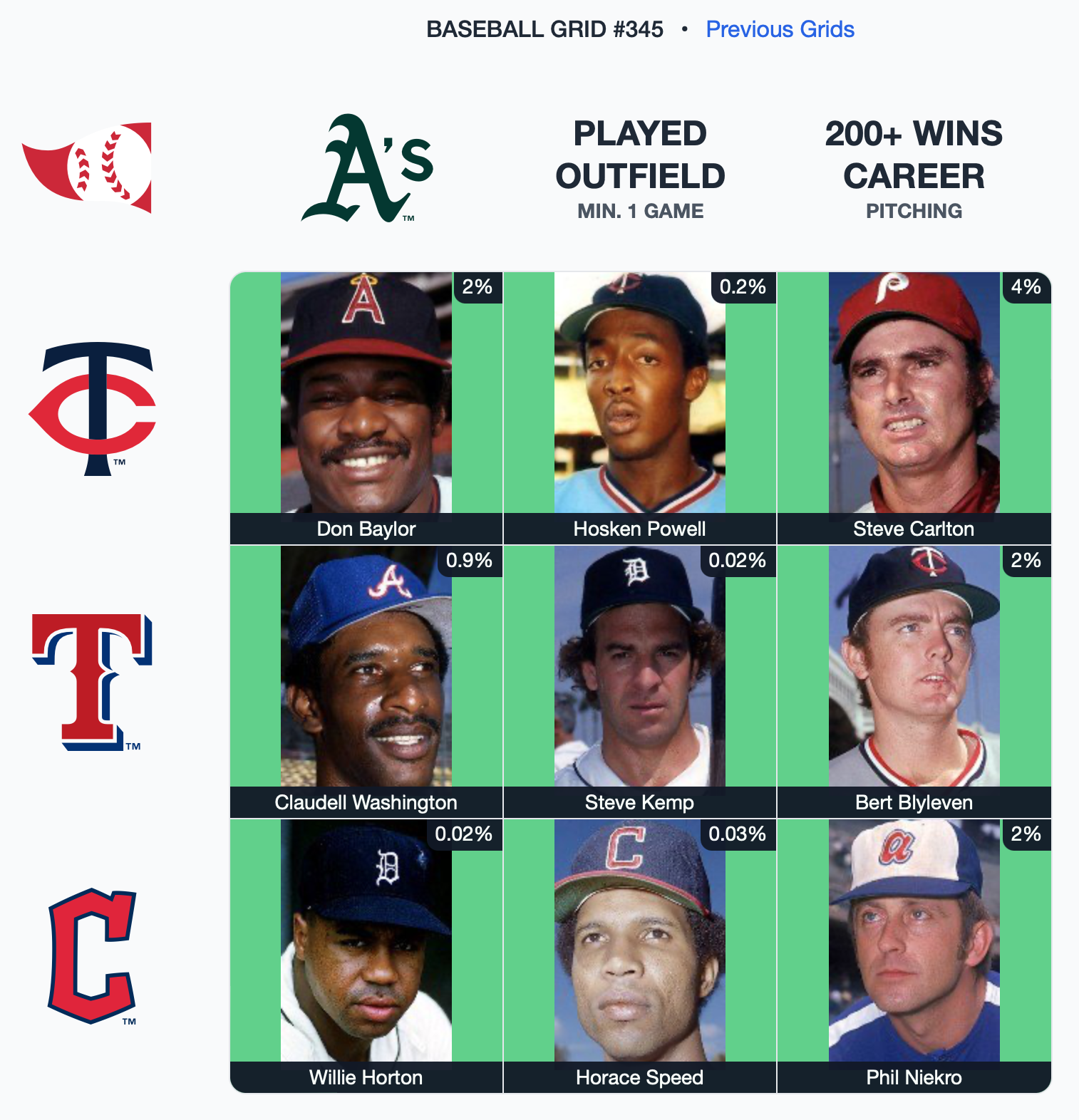
⚾️ Immaculate Grid 345 9/9 — Rarity: 11

If I had put Jack Morris in the top-right square, I could have had a Tigers bottom-right-to-top-left-diagonal Hollywood Squares win situation.

See you tomorrow.

The Friday Fungo

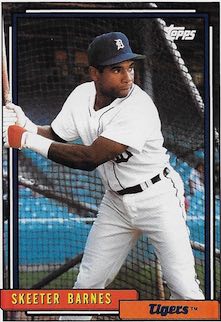
Skeeter Barnes – #9

This post should have been written yesterday, on William Henry “Skeeter” Barnes‘ birthday — he deserved better!

So, here are 10 things to know about a fun player from some mediocre Tigers seasons:

  1. Drafted by the Reds in the 16th round of the 1978 MLB June Amateur out of University of Cincinnati.
  2. He debuted on Sept. 6, 1983, against the Giants, in a game featuring Darrell Evans at shortstop, Dave Bergman at first, and Champ Summers pinch hitting.
  3. From 1983 to ‘84, he appeared in 47 games for the Reds. On April 26, 1985 the Reds sent him to the Expos for Max Venable. He appeared in 19 games for the ‘85 Expos.
  4. Barnes saw no major-league action in 1986, and on July 24 he was traded, with former Tiger Dan Schatzeder, to the Phillies for Tom Foley and Lary Sorensen.
  5. In 1987, he signed with the Cardinals but only appeared in four games. After spending 1988 in Triple A, he appeared in five games for the Reds.
  6. Then, on Jan. 21, 1991, he signed with the Tigers. After starting the year in Toledo, Barnes made his Detroit debut with gusto on June 14, in a 5-1 win in Seattle. He hit a solo homer in his first Tigers at bat, off Brian Holman, with two out in the first inning.
  7. Sparky used him just about everywhere: 1B, 2B, 3B, Shortstop, all outfield spots.
  8. From ’91 to ’94, he appeared in 278 games for the Tigers batting .281 with 11 homers, 73 RBI and a .739 OPS.
  9. Barnes’ final career hit came on June 16, 1994 — a single to right off the Brewers’ Bob Scanlan.
  10. His final major league appearance came on June 20, 1994, as a defensive replacement for Cecil Fielder at first base.

Birthdays

Mark Salas, Lance McCullers, Justin Thompson, Juan Encarnacion, Chris Lambert, Bob Stoddard, Joe Staton, Jim Small and the late Pete Fox, Ray Francis and Ollie O’Mara.

Today’s Grid

⚾️ Immaculate Grid 341 7/9 — Rarity: 275

Have a great weekend. See you tomorrow.

The Monday Fungo

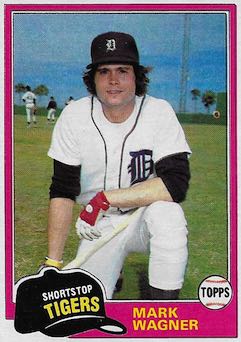
Mark Wagner – #5

Infielder Mark Wagner debuted on Aug. 20, 1976, in a 3-2 Tigers win over the Twins at Tiger Stadium. He went 2 for 3 with an RBI, highlighted by a single, off lefty Eddie Bane, in his first major league at bat.

Here are four things to know about the guy nicknamed Peanut:

Random Game: April 26, 1977

White Sox 10 – Tigers 7 (14 innings)

W: Lerrin LaGrow (1-0) – L: Steve Foucault (0-1) | Boxscore

More proof of how baseball has changed over the past 50ish years: A 14-inning game and Ralph Houk used only three pitchers: Dave Rozema started and went 7 innings, John Hiller went 6 in relief, and Steve Foucault pitched the 14th, giving up three runs.

  • This was Rozema’s third career start and appearance.
  • Aurelio Rodriguez and Phil Mankowski teamed up to go 5 for 6 on the day.
  • Fellow St. Clair Shores native Jim Essian hit a paid of doubles in 6 at bats.
  • LaGrow went six innings in relief agains his former team.
  • Ron LeFlore had a rough day at the plate: 1 for 7, but he doubled in a run.

Miscellany

  • Umpires: HP – Don Denkinger, 1B – Larry McCoy, 2B – Durwood Merrill, 3B – Dave Phillips.
  • Time of Game: 3:58.
  • Attendance: 6,396.
  • Start Time Weather: 60° F

Birthdays

Nick Castellanos, Jack Hannahan, Mark Wagner and the late Les Mueller.

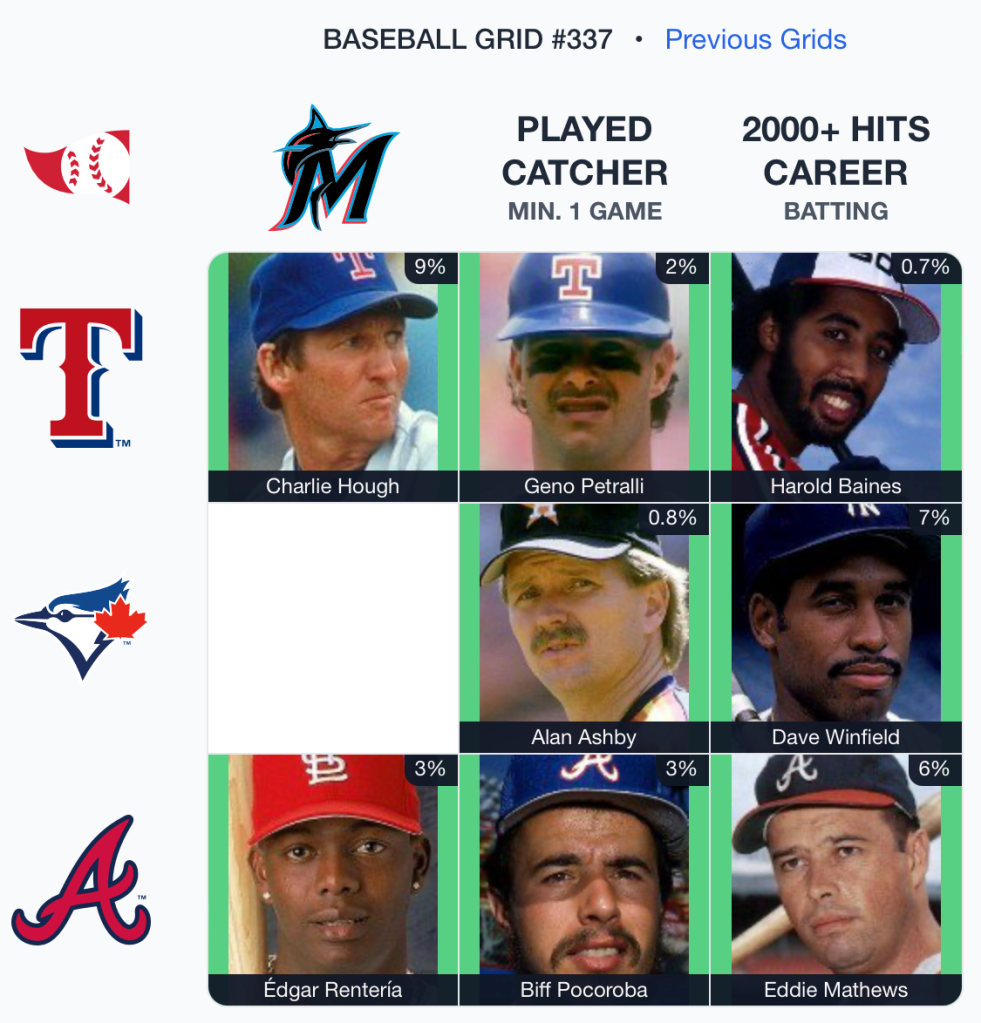
Today’s Grid

⚾️ Immaculate Grid 337 8/9 — Rarity: 132

See you tomorrow.

The Wednesday Fungo

Enos Cabell

The Tigers acquired Enos Cabell on March 4, 1982, in trade with the Giants for Champ Summers.

In 2011, Tom Gage wrote a piece in The Detroit News about Cabell (the original link to the article is here, but it’s not active for whatever reason) and I was interested to read why Cabell, who hit .311 for the 1983 Tigers, moved on after that season:

He wanted to stay a Tiger, and they weren’t averse to him staying.

“But they wouldn’t give me a raise,” Cabell said Saturday. “I hit .311, played with a knee brace the last two months of that year, and they wouldn’t give me a penny more.

“So I said bye-bye. I was pretty sure the Astros wanted me back, anyway.”

He filed for free agency on Nov. 7, 1983 and I couldn’t believe they let him walk away, especially after a solid ’83 campaign.

Six weeks later, on Dec. 17, 1983, the Tigers signed left-handed hitting Darrell Evans, a much-bigger power threat than the right-handed Cabell.

Then, of course, in March came the trade that defined the 1984 season: Willie Hernandez and Dave Bergman for Glenn Wilson and John Wockenfuss.

Who knows how that would have come about if they had re-signed Cabell? A few years later this news broke — and on this date in 1986 — and you have to wonder if this played into the Tigers thinking in the fall of ‘83.

Commissioner Peter Ueberroth gives seven players who were admitted drug users a choice of a year’s suspension without pay or heavy fines and career-long drug testing, along with 100 hours of drug-related community service. Joaquín Andújar, Dale Berra, Enos Cabell, Keith Hernandez, Jeffrey Leonard, Dave Parker, and Lonnie Smith will be fined ten percent of their annual salaries to drug abuse programs. The commissioner also doles out lesser penalties to 14 other players for their use of drugs.

Cabell’s career numbers in Detroit: .284 average, 7 homers, 83 RBI, .682 OPS.

Birthdays

Niko Goodrum, Chad Bell and the late Ron Samford and Lil Stoner

Today’s Grid

⚾️ Immaculate Grid 332 9/9 — Rarity: 9

I’m particularly proud of this one!

See you tomorrow.

The Trade, 25 Years Later

Want to feel old? Try this on for size:

It was a quarter-century ago — March 24, 1984 — that the Tigers acquired relief pitcher Willie Hernandez and first baseman Dave Bergman from the Philadelphia Phillies for catcher John Wockenfuss and outfielder Glenn Wilson.

And the insanity that was the Summer of ’84 began.

In case you’ve forgotten, Hernandez won the American League MVP and Cy Young awards after saving 32 games with an 1.92 ERA and 140.1 innings in 80 pitching appearances.

Good times.

The 1984 Hernandez/Bergman Trade Revisited

In case you’d forgotten, it was 24 years ago this week that the Tigers swung a deal with the Phillies that changed the 1984 season for the Tigers dramatically — and instantly.

On March 27, 1984, the Tigers acquired lefty reliever Willie Hernandez and first baseman Dave Bergman from Philadelphia in exchange for OF Glenn Wilson (my favorite Tiger back then) and all-purpose guy John Wockenfuss.

With World Series expectations higher than perhaps ever in Tigers history and the team searching, as it was in 1984, for bullpen reinforcements, let’s look back on a trade for the ages.


Willie

There was no reason to expect the moon from Willie Hernandez as the Tigers’ new closer. After his trade to the Phillies from the Cubs on May 22, 1983, he went 8-4 with a 3.29 ERA and seven saves in 63 appearances, primarily as a setup man for closer Al Holland.

But, as if I need to remind you, in 1984 Hernandez put together the career year to end career years: 9-3, 32 saves, 1.92 ERA, 80 appearances, 140 IP, All Star, American League Cy Young Award winner and Most Valuable Player.

Sparky had lots to say about Willie Hernandez in his book about the ’84 season, Bless You Boys. Here’s some of it:

I’ve been in baseball for 31 years, and there’s no way I can believe what I saw in Willie Hernandez this year.

Don’t ask me to explain Willie. How do you explain a miracle? Every time Willie had a chance for a save, Willie got it. Every time we desperately had to have a win, Willie was there. When I read that Hernandez didn’t pitch in 82 of the Tigers regular-season games in 1984, I find it hard to fathom. As a kid it seemed as if he pitched every day. And as Sparky said, when he did pitch, good things usually happened.

Thanks to his miracle season, Hernandez, who wore number 21, cashed-in on a big contract extension with the Tigers and, at age 29, appeared to be the closer for the long term.

In 1985, he turned in a decent year, though spoiled-rotten Tigers fans took to booing Hernandez regularly. He had an astonishing 18 decisions (8-10) even though he compiled stats that current Detroit fans would love to see from Todd Jones: 31 saves, 2.70 ERA.

From 1986 until his final year in Detroit in 1989, Hernandez’s save totals fell from 24 to 8 then bumped up to 10 and 15. Meanwhile his ERA headed north rapidly, topping out at 5.74 in ’89 — when the entire franchise bottomed out.

The Tigers released him on Dec. 20, 1989. He never appeared in another major-league game. All told, Willie Hernandez finished his Tigers career with a 36-31 record, 120 saves and a 3.44 ERA.


Bergie

Dave Bergman was traded twice on March 24, 1984. The first deal sent him from the Giants to the Phillies for Alejandro Sanchez. (Interestingly, almost a year later, the Tigers sent Roger Mason to San Francisco for Sanchez) The Phillies quickly spun-off Bergman to Detroit. Most thought he would replace Wockenfuss as a part-time first baseman and outfielder. In reality, he became a workhorse defensive replacement for newly acquired Darrell Evans at first base.

In 1984, Bergman made a quick impact with his glove and, as the season wore on, with some clutch, late-inning heroics.

In the bottom half of the eighth inning at Comiskey Park on April 7, Sparky put Bergman in at first base as a defensive replacement for Barbaro Garbey. The White Sox’ Jerry Hairston ripped a groundball down the first-base line. Bergman, playing close to the line, slid to his left and snuffed the grounder for the first out of the inning but more importantly, protected Jack Morris‘s no-hitter.

(Nearly a year earlier, Hairston crushed Milt Wilcox‘s bid for a perfect game with two outs in the bottom of the ninth. That’s what we call karma.)

On June 4 in Detroit against the Blue Jays, Bergman had what Sparky called the greatest at bat he’d seen in his life. Let’s allow Captain Hook describe it, again from the pages of Bless You Boys:

Here’s the scene: Two out in the last of the tenth, two men on, and the score tied at 3-3. Reliever Roy Lee Howell (sic) pitched to a full count. Then Bergie took over. Bergie fouled off seven pitches and then picked one practically off the ground and drilled it into the upper deck in right.What a battle! Bergie was up there a full seven minutes. It seemed like a whole season. The house went wild.

Actually, Bergman’s homer came off Roy Lee Jackson, which surprised me because I thought it was Luis Leal.

What made that game so much fun was that it was the season opener for ABC’s Monday Night Baseball, which was much bigger back then than ESPN’s Wednesday or Sunday night games are today. Also, school was almost out for summer and my friends and I were fired up for lots of excursions to Tiger Stadium’s bleachers.

During the 1984 season, Bergman appeared in 120 games, 114 at first base and one each in right and left field. He finished the year with a .273 average, seven home runs and 44 RBI. Defensively, Bergman made just eight errors in 732 chances, a .989 fielding percentage.

Wearing Wockenfuss’s number 14, Bergman became a mainstay with the Tigers. In nine seasons in Detroit he batted .252 with 39 home runs and 219 RBI. He retired after the 1992 season but remained in metro Detroit working in financial services.

Looking at the trade nearly a quarter century later, Detroit undoubtedly benefited the most. The Tigers got six seasons of work from Hernandez and nearly a decade from Bergman. Though the Phillies got barely a season and a half from Wockenfuss (whom we profiled here), Wilson had three respectable seasons in Philadelphia. In 1985, he batted .274 with 14 home runs and 102. The next season, he batted .271, 15 homers and 84 RBI.

Still, chances are only the most-diehard Phillies fan could point out any impression Wilson or Wockenfuss made on those mid-1980s Philadelphia teams. Tigers fans, however, remember vividly the contributions of Willie Hernandez and Dave Bergman.

Happy Birthday, Johnny B.

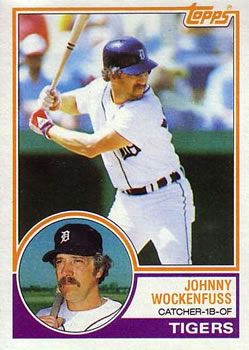
The first time my brother imitated the finger-waving batting stance of a Tigers player by the name of “Wockenfuss” I was convinced he made it up.

Not only did the name sound like a cartoon character, the flapping of the right hand on the bat was too much for my nine-year-old brain to process as a viable approach at the plate.

I soon learned that Johnny Bilton Wockenfuss was – and is – a real-life person.

Never a superstar, he was a Super Sub before the phrase existed. He played key roles for the Tigers and helped the club bridge the gap between emerging contender and World Series Champion.

‘Fuss was drafted by the Washington Senators in the 42nd round of the 1967 amateur draft. His road to Detroit wound through Arlington, Texas, after the Senators relocated following the 1971 season.

On June 6, 1973 he was traded by the Rangers with Mike Nagy to the Cardinals for Jim Bibby. Less than six months later – on Dec. 3 – St. Louis sent him to the Tigers for minor-leaguer Larry Elliott.

Ironically, Wockenfuss made his major league debut on Aug. 11, 1974 against the Rangers at Arlington Stadium – and faced the pitcher he was traded for a year earlier, Bibby.

He started at catcher, as he would 12 more times that season, and, batting ninth, went 0 for 2 with a walk. In his first big-league at bat (leading off the Tigers third) he popped out to shortstop Toby Harrah.

Wockenfuss’s first major league hit would come three days later at Tiger Stadium off Royals starter Steve Busby — an RBI single with two outs in the ninth (Jim Nettles, brother of Graig scored).

During the lean years of the mid-1970s, Johnny B. – wearing first #45 and then, from 1976 on, #14 – steadily gained playing time, primarily behind the plate for manager Ralph Houk. When Sparky Anderson was hired in 1979, ‘Fuss became more of a first baseman/outfielder/DH hybrid.

For the next four seasons, Wockenfuss had a .265 average. His best year at the plate for Detroit was in 1982 when hit batted .301 in 79 games.

In the spring of 1984, the buzz around Lakeland was of a team poised to make the leap to the postseason. Wockenfuss had been so valuable to the Tigers over his 10 seasons that no one suspected he wouldn’t be with Detroit on Opening Day.

But on March 24, 1984, roughly one week before the Tigers opened the season in Minnesota, ‘Fuss was traded with outfielder Glenn Wilson to the Phillies for Willie Hernandez and Dave Bergman.
We know how that played out.

In Philadelphia that year, Wockenfuss played in 86 games, mostly at first base, batting .289. In 1985, he appeared in just 32 games, collecting six hits. When the Phillies released him on Aug. 19, 1985 – almost 11 years to the day of his debut – his career was over.

Two years later, though, he was back in the Tigers organization as the manager of Lakeland in the Florida State League. He appeared to be on a meteoric rise in the organization. In 1988 he led the Glens Falls Tigers of the Eastern League two a first-place finish. The next season he was promoted to manager of Toledo where the Mud Hens finished in sixth place. He lasted only 24 games of the 1990 season before he was fired on April 29.

And that was all she wrote for Johnny B. Wockenfuss as a member of the Tigers family.

I remember feeling bad in 1984 that Johnny B. wasn’t around to enjoy the Tigers World Series championship. Years later when the Pistons won their first NBA Title they had some of the old guard on hand for the celebration. Too bad Wockenfuss couldn’t have participated in a similar sort of revelry in October ’84.

Raise a glass today for Johnny B. Wockenfuss. He’s 59.