April 27, 1984: Indians 8 – Tigers 4 (19)

April 27, 1984: Indians 8 – Tigers 4 (19)

WLuis Aponte (1-0) – LGlenn Abbott (1-1) | Boxscore

Record: 16-2

Highlights

  • Both teams scored in the 10th — which Sutcliffe started and quickly departed after allowing a leadoff double to Lou Whitaker, who went 3 for 7 on the night. (Poor Cleveland DH Andre Thornton went 0 for 9.)
  • After eight scoreless extra innings, the Indians broke through in the 19th, dropping four runs on Abbott — who was in his fifth inning of relief.
  • The Tigers made four errors in the game.
  • Had the game remained tied after the 19th, under American League rules, it would have been suspended.
  • This was also the night of the epic Pistons/Knicks Game 5 playoff game held at Joe Louis Arena due to the Silverdome’s collapsed roof. Isiah scored 16 points in 94 seconds in the fourth quarter to force OT … but the Pistons lost 127-123.

Miscellany

  • Venue: Tiger Stadium
  • Umpires: HP – Rocky Roe, 1B – Larry Barnett, 2B – Dale Ford, 3B – Ken Kaiser
  • Time of Game: 5:44
  • Attendance: 34,112

Birthdays

Frank CatalanottoBob MacDonald and the late George Archie and George Winter 

See you tomorrow.

April 25, 1984: Tigers 9 – Rangers 4

1984 Game 16: Tigers 9 – Rangers 4

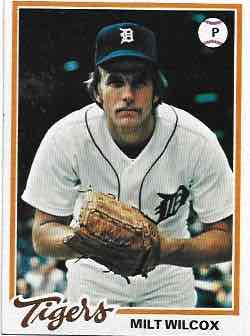
W: Milt Wilcox (2-0) – L: Dave Stewart (0-5) – Save: Willie Hernández (2) | Boxscore

Record: 15-1

Highlights

  • Wilcox went six innings, allowing six hits and two runs.

Miscellany

  • Venue: Arlington Stadium
  • Umpires: HP – Al Clark, 1B – Don Denkinger, 2B – Dan Morrison, 3B – Mike Reilly
  • Time of Game: 2:38
  • Attendance: 25,883

Bill Krueger #30

Here are a few things to know about lefty Bill Krueger:

Bill Krueger, not displaying his tremendous high leg kick.
  • The Tigers signed Krueger on Dec. 11, 1992. He spent the ’92 season with the Twins and Expos.
  • He made his Tigers debut on April 7, 1993 against his original club, the A’s, in a 12-7 Tigers loss. His line: 3.1 IP, 5 hits, 2 runs, 3 walks and 3 strikeouts.
  • The 1994 Tigers were not good and Krueger’s year aligned with his team’s. He had appeared in 16 games — his last a June 2 start against the Orioles in Baltimore — before the Tigers released him on June 4, with an 0-2 record and a 9.61 ERA.
  • Bill Krueger’s final line in Detroit: 6-6 with a 4.60 ERA.

Birthdays

Daniel Norris, Jacque Jones, Larry Pashnick and the late Tony Phillips, Woody Davis and Fred Haney

See you tomorrow.

The Saturday Fungo: April 6

Game 3 – April 6, 1984

Tigers 3 – White Sox 2

W: Milt Wilcox (1-0) – L: Richard Dotson (0-1) – Save: Willie Hernandez (1) | Boxscore

Highlights

  • The Tigers score three in the first to spoil the White Sox’s (is that grammatically correct?) home opener.
  • Record: 3-0

Miscellany

  • Umpires: HP – Jim McKean, 1B – Durwood Merrill, 2B – Tim McClelland, 3B – Marty Springstead.
  • Time of Game: 2:51
  • Attendance: 42,692

Birthdays

Ken Williams, Western Michigan U’s Phil Regan and the late Mickey Cochrane

Today’s Grid

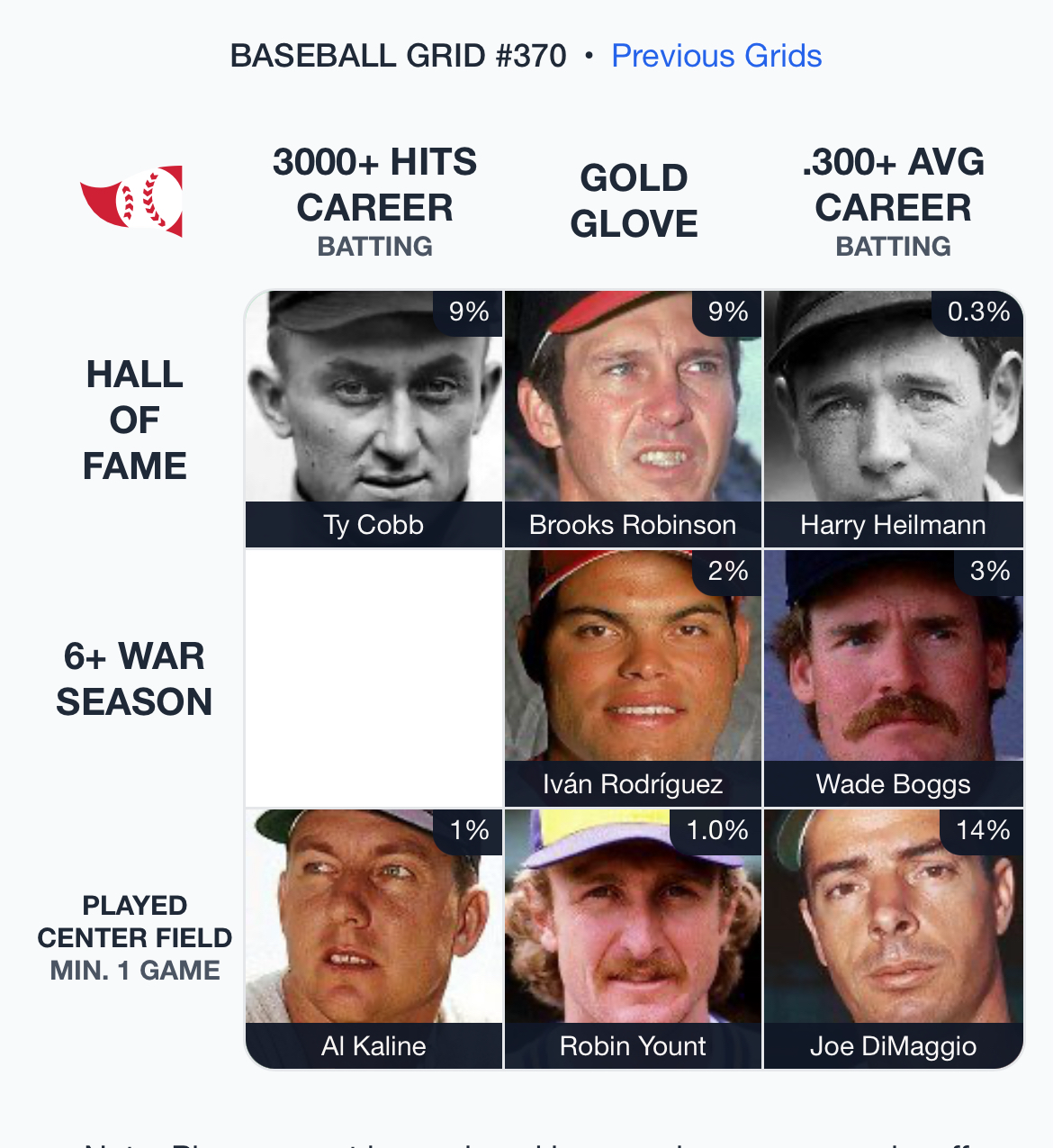
⚾️ Immaculate Grid 370 8/9 – Rarity: 140

A swing and a miss on Chet Lemon in the bottom middle square.

See you tomorrow.

The Saturday Fungo

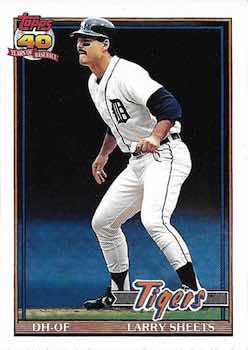
Larry Sheets – #9

After the misery of the 1989 season, Bill Lajoie got to work in the offseason adding hitters to a lousy roster.

Cecil Fielder, Tony Phillips and Lloyd Moseby were the headliners, but an under-the-radar guy was lefthanded-hitting outfielder Larry Sheets.

After six years in Baltimore, Sheets was dealt to Detroit for infielder Mike Brumley.

Here are five things to know about Sheets’ time with the Tigers:

  • Final line: 131 games, .261 average, 10 HR, 52 RBI, .710 OPS
  • All of his home runs came off right handers, and all but one of his RBI came of righties.
  • Bonus item: He’s the father of White Sox outfielder/first baseman Gavin Sheets.

Birthdays

Jack Lazorko and the late Ed Gremminger

Today’s Grid

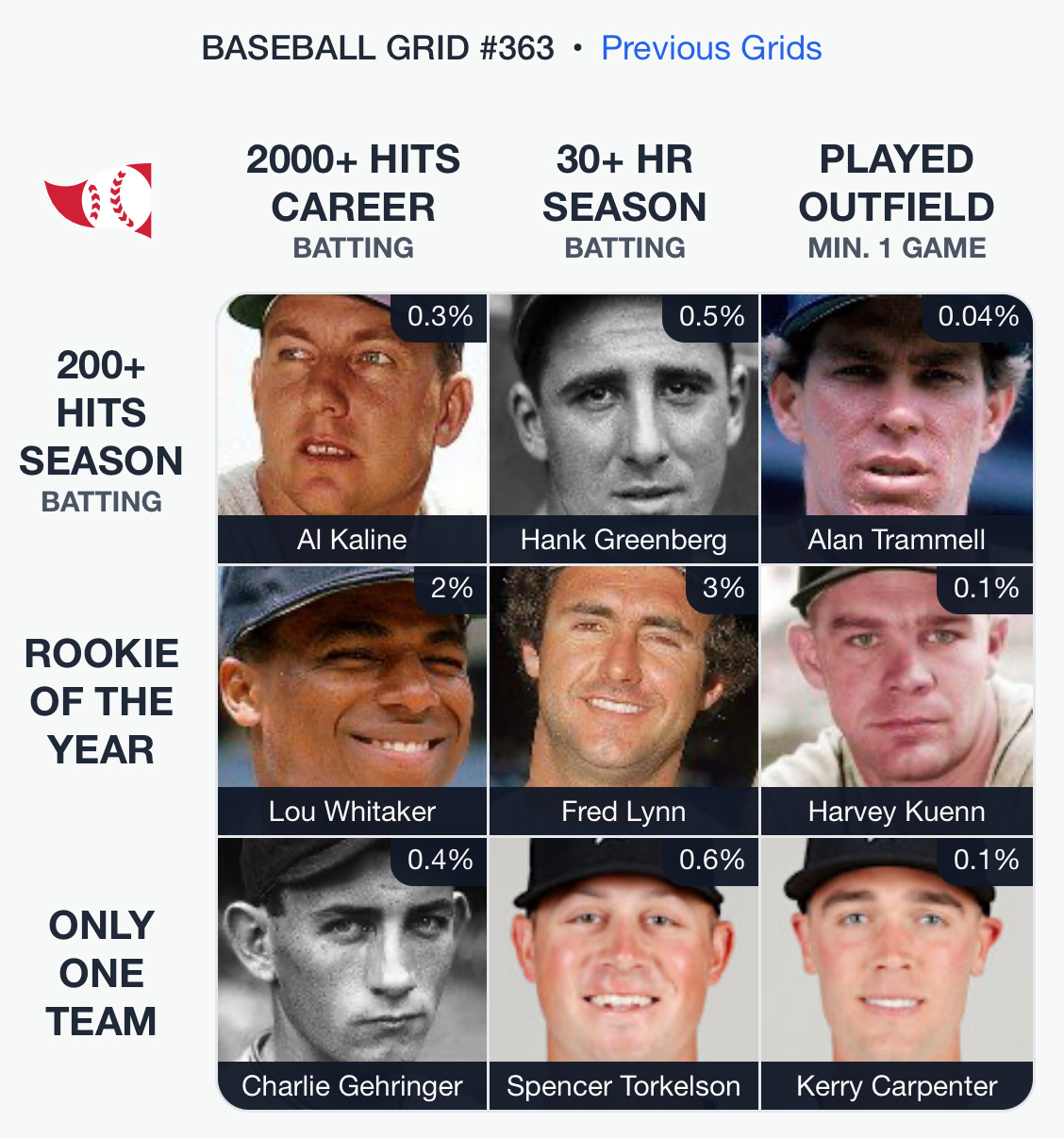
⚾️ Immaculate Grid 363 9/9 — Rarity: 7

An all-Tiger, lowest-rarity Grid today!

See you tomorrow.

The Sunday Fungo ☘️

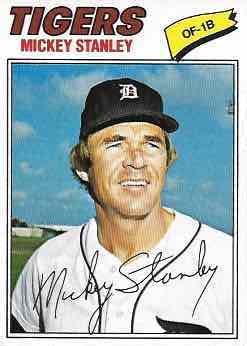
Mickey Stanley – #24

For many fans, Mickey Stanley’s defining moment with the Tigers came in the 1968 World Series when manager Mayo Smith shifted him from the outfield to shortstop — a position he’d played only in nine major-league games.

The move was made specifically to keep Al Kaline in the lineup while adding some pop to the ’68 team’s woeful production at shortstop. Ray Oyler played most at short that year (111 games) but hit just .135, while backups Tom Matchick and Dick Tracewski combined hit .180 (!).

In his terrific bio on Stanley, which appears in the 2008 book Sock It to ‘Em Tigers, Jerry Nechal sums up the new shortstop’s performance in the Series against the Cardinals:

Obviously a quick learner, Stanley went on to amaze the baseball world in the Series. In the first inning of Game 1 he was tested by a leadoff ground ball off the bat of the speedy Lou Brock. Brock was out on a close play and Mickey’s fielding at shortstop became a nonfactor. He successfully handled 30 of 32 chances, making two inconsequential errors.

Mickey Stanley broke in with the Tigers on Sept. 13, 1964, singling in his first at bat off Claude Osteen, and appeared in just four games that season. He played in 30 games the following season before making the big club out of Spring Training in 1966, and soon became a fixture in centerfield for the Tigers until a speedy rookie Ron LeFlore took over in the mid-’70s.

My greatest memory of Stanley comes from Aug. 10, 1977, the first Tigers game I ever attended.

The starting pitcher for the Tigers was rookie Jack Morris who would pitch 7.2 innings on the way to his first major-league win, but he wouldn’t have gotten the win that night without a dazzling play by Stanley with two out in the ninth inning.

With Von Joshua at first, Cecil Cooper stood at the plate as the potential tying run. He launched a pitch from Steve Foucault deep to right field and from my lower deck seats on the first base side, it looked like it would indeed tie the game. Instead, Stanley timed his jump and took away a home run, securing a 5-3 win for the Tigers — and Morris.

And it took no time for me to decide who my favorite Tigers were.

Mickey Stanley retired after the 1978 season, his 15th, after playing in 1,516 games — all with the Tigers.

Birthdays

Vance Wilson and the late Oscar Stanage

Today’s Grid

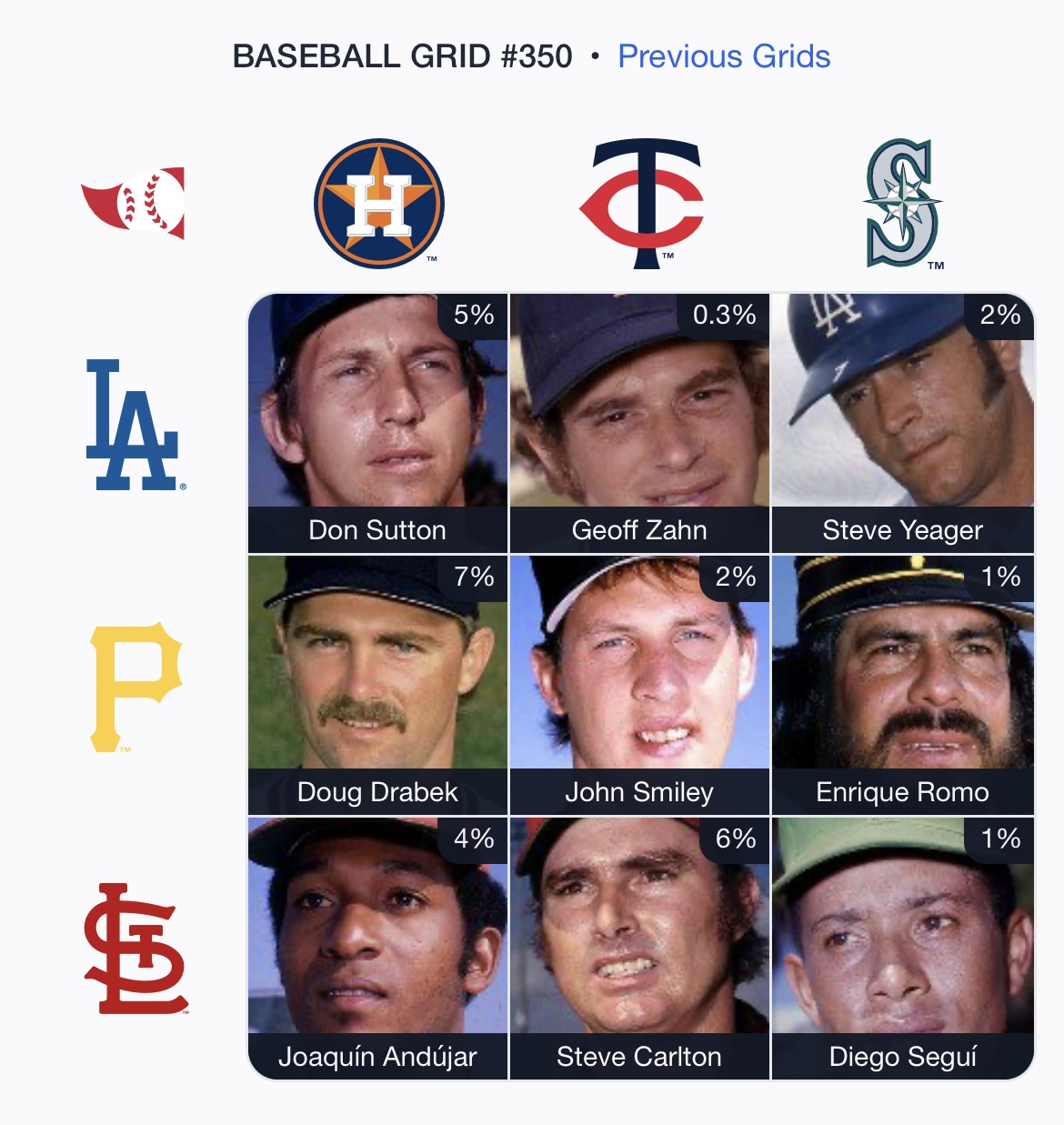
⚾️ Immaculate Grid 350 9/9: Rarity: 29

As I told my pal Doug, add 100 to my rarity score because. out of frustration, I looked at the 1977 Mariners roster to see who I remembered as a Cardinal. For kicks, I dropped him in to see how rare it was — rare!

See you tomorrow.

The Monday Fungo

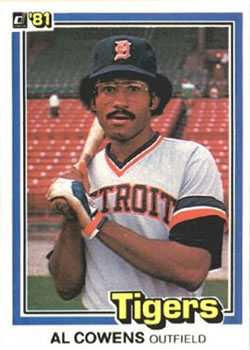
Al Cowens – #10

Stop me if you’ve read this here before: When the Tigers traded Jason Thompson for Al Cowens, I was not a happy 12 year old.

But Cowens was an intriguing player to me because he was on those great Royals teams in the late-’70s.

Presumably the Tigers and Angels, at the time of the trade, thought a change of scenery would help both players — and it seemed to work.

  • Cowens was hitting .227 with the Angels with a homer, 17 RBI and a .597 OPS. As a Tiger, he hit .280 in 108 games, with five homers, 42 RBI and a .709 OPS. All told, his 1980 line was: .268, six homers, 59 RBI and a .684 OPS.
  • Thompson hit just .214 with four homers, 20 RBI and a .638 OPS, in Detroit, but warmed up quickly in Anaheim: .317, 17 home runs, 70 RBI and a .965 OPS. He finished the year at .288, 21 home runs, 90 RBI and .873 OPS.

Just four days after the trade, Cowens made his Tigers debut* against the Angels on May 30, 1980 at Tiger Stadium. He batted fifth, going 2 for 5 with a run scored.

*Thompson made his Angels debut on May 28 against the Rangers, pinch hitting for catcher Tom Donohue. He hit a bases-loaded double off Sparky Lyle, clearing the bases, and scored when Dickie Thon drove him home.

In 1981, Cowens appeared in 85 games for the Tigers, hitting .261 with one home run, 18 RBI and a .667 OPS … and that was it for his time in Detroit.

On March 28, 1982, the Mariners purchased his contract and he had a nice bounce-back year in Seattle, hitting .270 with 20 home runs, 78 RBI and an .800 OPS.

Cowens’ final game with the Mariners, and in the majors, was June 8, 1986. The club released him four days later.

Birthdays

The late Bill Lawrence and Art Ruble.

Today’s Grid

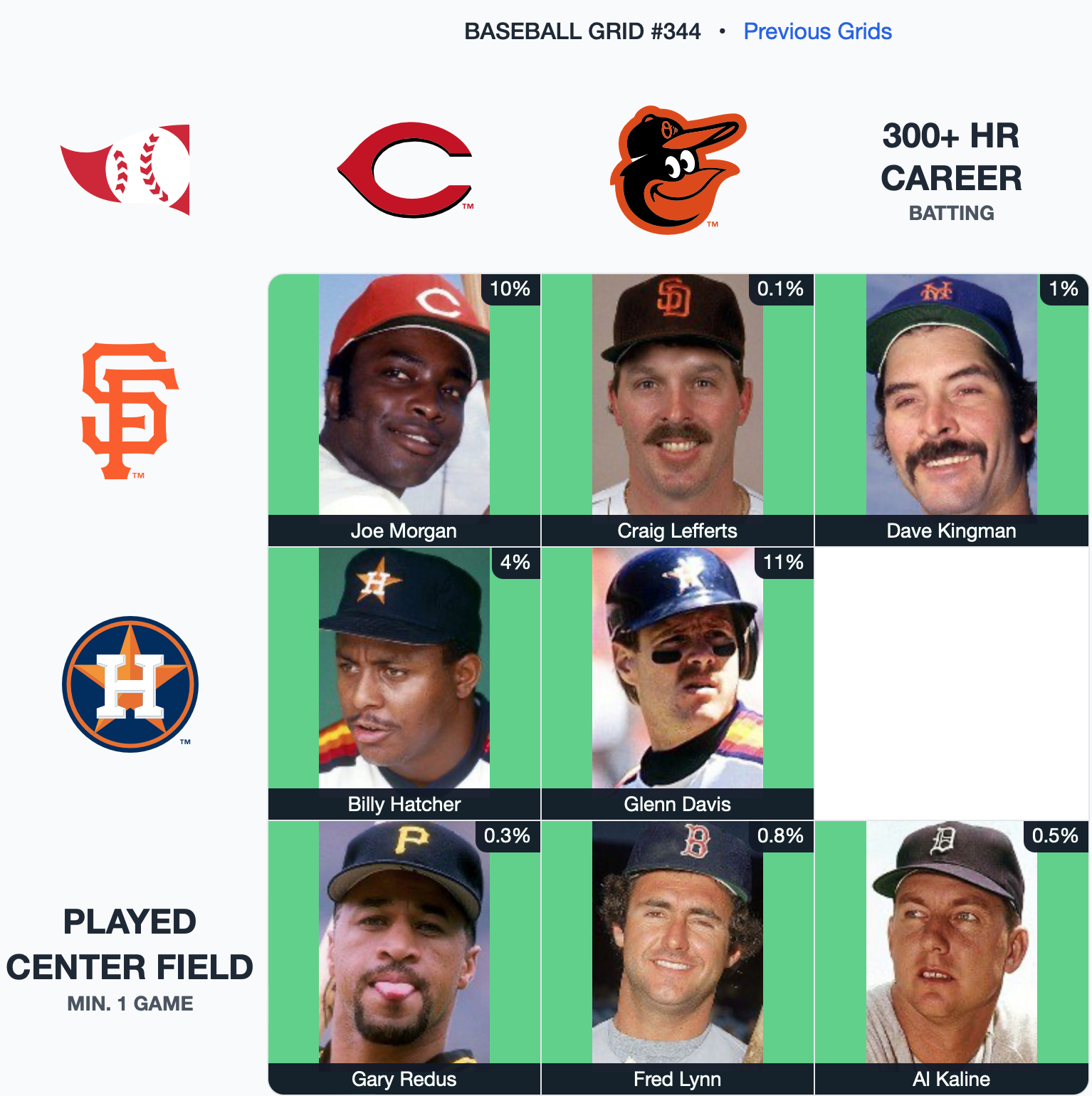
⚾️ Immaculate Grid 344 8/9 — Rarity: 129

See you tomorrow.

The Saturday Fungo: Feb. 17

An Afternoon at the Ballyard

I spent the day at Camelback Ranch, the spring training home of the Dodgers and White Sox, watching my alma mater, Western Michigan, come from ahead to beat Michigan, 11-9 in 10 innings.

Imagine my surprise when I noticed that former Tiger Daniel Schlereth is the Broncos’ pitching coach.

Here’s the final out.

Western Michigan vs. University of Michigan — Camelback Ranch, Glendale, Ariz. February 17, 2024

Birthdays

Danny Patterson and the late Roger Craig, Jack Crimian, Orlin Collier, Eddie Phillips, Eddie Onslow and Wally Pipp.

Today’s Grid

Avert your eyes.

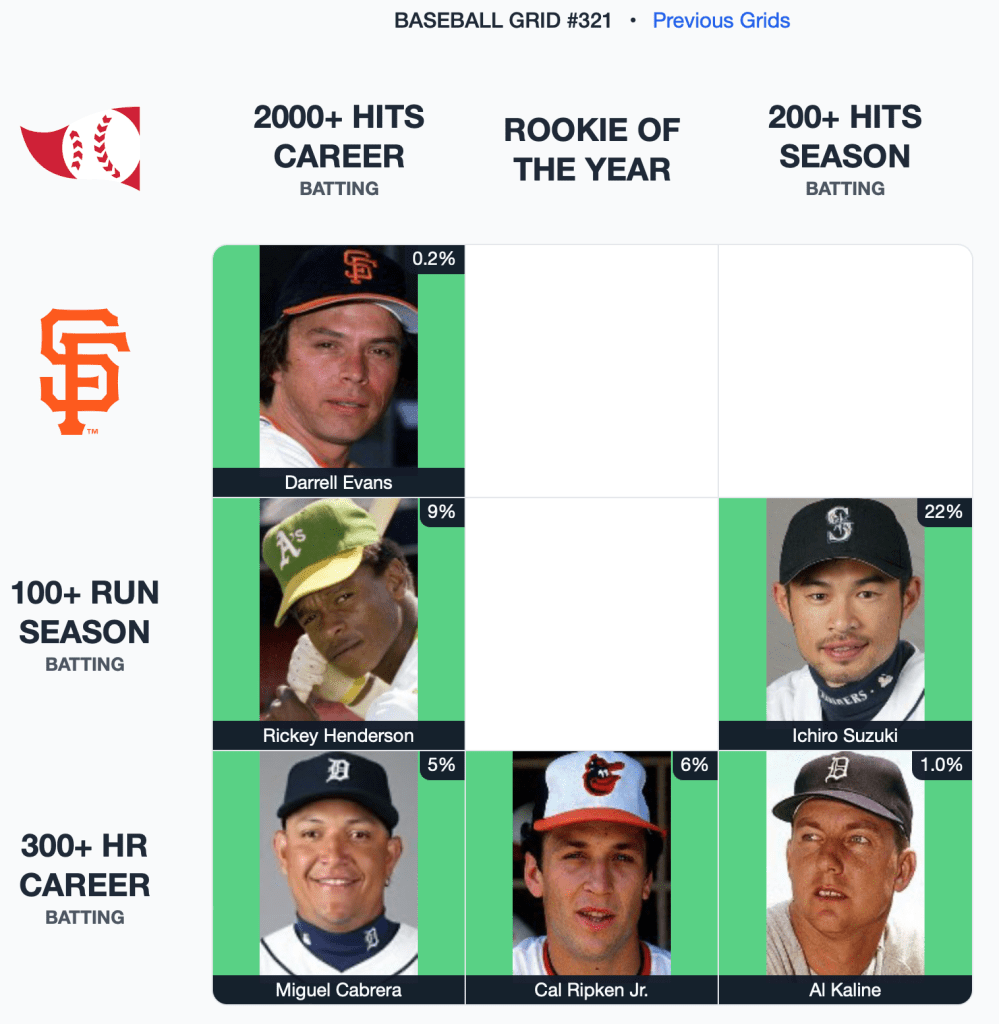
⚾️ Immaculate Grid 321 6/9: Rarity: 343

I hope you’re having a great weekend.

Ralph Houk: Bridge between Martin and Anderson (and technically Les Moss)

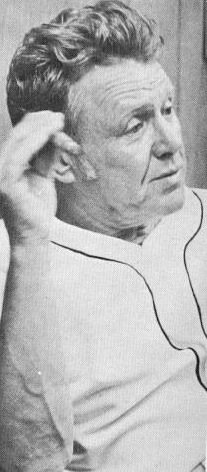
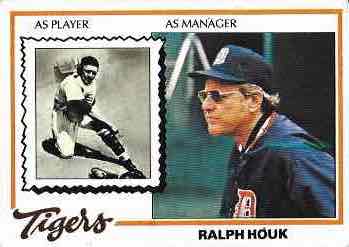
Ralph Houk was the first Tigers manager I ever knew. I paid more attention to the players then – Jason Thompson, Steve Kemp and Aurelio Rodriguez – but I now wish I would have had the attention span to listen to his post-game interviews on Channel 4 or on WJR. I was only nine when baseball appeared on my radar so I’ll have to remember Houk, who died on July 22, 2010, at the age of 90, through the pages of my Tigers Yearbooks and media guides.

Or so I thought.

Thanks to the magic of the Internet, we can piece together Ralph Houk’s arrival in Detroit, where he presided over one of the bleakest periods of baseball in the city’s history, and displayed the least managerial charisma this side of Luis Pujols.

October 1973: Replacing Billy Martin

How bad were the New York Yankees in the early 1970s? Bad enough that their manager left the Bronx for the same job with the Tigers. That might be a stretch, but not by much. The 1973 Tigers finished 85-77, third in the six-team American League East, five games ahead of the 80-82 Yankees. So one could guess that Detroit was actually a step up. It was at least in the view of Ralph Houk, who won 970 games in New York over 10 seasons and was the successor to the legendary Casey Stengel. He would have nowhere near that success with the Tigers.

So, why would he leave New York? According to his obituary in The New York Times, not surprisingly, the reason was The Boss:

In January 1973, a syndicate headed by [George] Steinbrenner bought the team. Under CBS, Houk had a free hand on the field while Lee MacPhail handled the front-office duties. But Steinbrenner let Houk know how he felt things should be done and was overheard making derogatory comments about some of the players.

Houk resigned on the final day of the 1973 season, despite having two years remaining on a contract that paid him in the neighborhood of $75,000 per year. It would be roughly the same amount Tigers GM Jim Campbell would pay him each of the three years on his contract – which at the time made Houk the highest-paid manager in Tigers history.

So what was Houk’s vision when he came to Detroit? To erase “the thin line between losing and winning”, and to rebuild “but not make change for the sake of change.” That’s what he told the AP during his introductory press conference at his Oct. 11, 1973 introductory press conference – at which he was two hours late due to a series of flight delays. (Couldn’t get a direct flight from New York?) “I like the batting power. That’s what always worried me when we played Detroit,” Houk told the UPI.

And he knew of what he spoke: the Tigers trailed only the Indians in 1973 in home runs (157); in 72 they finished third behind Boston and Oakland with 122. Detroit led the league with 179 in 1971.

During his first press conference, Houk also told reporters that he wanted Al Kaline to be his designated hitter in 1974. And Kaline was the Tigers primary DH that season, hitting .262 with 28 doubles, 13 HR, 64 RBI and a .726 OPS in his final season. The mid-1970s didn’t provide Tigers fans much in the way of relevance in the American League East standings. But they weren’t expected to contend. Houk’s job was to develop the Tigers young players and clear the runway for a contender in the 1980s – if not sooner.

Though he was at the helm for one of the most dreadful seasons – 1975, when the club finished 57-102, the fifth-worst season in team history – and one of the most captivating stories of the decade, if not franchise history: Ron LeFlore’s journey from Jackson State Prison to Tiger Stadium.

Houk’s Tigers had nowhere to go but up in 1976 – and they did, winning 17 more games and improving to 74-86. The story in 1976, of course, was Mark Fidrych, who emerged from fringe prospect to national sensation and became the star-attraction on a team filled with journeymen. Fidrych, of course, went 19-9, started the All-Star Game and won the American League Rookie of the Year Award.

Turning the Corner Slowly

It was in 1977 that Houk and the Tigers began introducing fans to the young players that would become the core of the 1984 World Series champions. That season, Alan Trammell, Lou Whitaker, Lance Parrish, Jack Morris and Dan Petry arrived in Detroit to join Kemp and Thompson. The club finished 74-88 in fourth place an improvement over the fifth-place finish in 76 but not really. The expansion Blue Jays joined the American League East that season serving as the rising tide to lift every team in the standings.The Tigers seemed to turn the corner in 1978, finishing with their best record under Houk, 86-76, but dropped to fifth place.

“It’s time for me to go fishing.”

On Sept. 21, 1978, Houk surprised the Tigers when he announced his retirement at the end of the season. The 59-year-old Kansas native wanted to spend his summers at the fishing hole, but on the way out he wanted to stick it to the media, whom he saw as never giving him a fair shake in Detroit.

“The pressure of you people, the press that’s been the toughest thing,” he told the AP when he announced his retirement. Then with a laugh he added, “You can’t slap writers any more. You can’t punch them. You can’t do anything. A lot has changed.”

“I’ve been treated so great here,” Houk was quoted by the UPI. “It’s been an interesting job but the only way I could have stayed here five years was my associations with Mr. Campbell and Mr. Fetzer.” “Truthfully, I did not intend to stay here this long,” Houk said. “It’s been gratifying to me to see some of the young players we have stuck with develop.” Check this out from the same UPI story:

Houk, 59, originally signed a three-year contract to manage the Tigers but it was replaced after 1976 with a unique self-renewing agreement that raised his pay above the average of his contemporaries and provided for additional attendance and club performance bonuses.

It also had a built-in year of severance pay should the contract be terminated by either side. Campbell had said repeatedly Houk could manage the Tigers for as long as he wanted.

Performance bonuses? Attendance clauses? And for all these years we thought the Tigers brass was living in the 1920s. Knowing Campbell’s cheapskate reputation, I’d guess those attendance bonuses were unattainable given the quality of the ball club.

All told, Houk’s Tigers teams won 363 games and lost 443 from 1974-78. Hardly outstanding but probably right in line with what Campbell expected when he hired him.

The Tigers named Les Moss, then the manager of their Triple-A Evansville club, to replace Houk for the 1979 season. As we know, that experiment lasted all of 53 games before the Tigers cut him loose in favor of Sparky Anderson.

Houk returned to the dugout in 1981 as manager of the Red Sox, a job he held until 1984. I remember thinking at the time that it had to be strange for Houk to be back at Tiger Stadium in ’84 watching many of his former players steamroll their way to the World Series. Or gratifying … or both.

By most accounts, Ralph Houk wasn’t a warm human being, particularly with the press, but he was probably the ideal man for the job. And that job was to bridge the gap between the 1968 champions and the next generation of Tigers, the guys who won the World Series in 1984. He’ll never have the legacy of his successor, Sparky Anderson, but Ralph Houk’s place in Tigers history is an important one – if often forgotten.

1961 Tigers: 101 Wins, But No Pennant in Detroit

If any term could describe the Detroit Tigers of the 1950s, a charitable one would be
uninspired.

A 95-win season in 1950 gave Tigers fans hope that some of the magic from the 1945 World Series championship would continue into the new decade.

Alas, the glory days quickly faded and the Tigers finished the Fifties 64 games under .500, at 738-802. Tigers fans looked to a new decade as a clean slate, a chance to renew past excellence.

Unfortunately, the 1960 Tigers didn’t cooperate. Though the team was stocked with premium young talent including sluggers Al Kaline, Rocky Colavito and Norm Cash, and an outstanding one-two punch in the starting rotation in Frank Lary and Jim Bunning, the Sixties got off to a bumpy start. The Tigers finished 1960 at 71-83, sixth in American League ahead of only a surprisingly weak Red Sox team, and the Kansas City A’s. That club churned through three managers: Jimmy Dykes, who was fired 96 games into the season, Billy Hitchcock (who managed all of one game) and Joe Gordon.

For 1961, the Tigers again changed leaders, hiring their fourth manager in a year, Bob Scheffing, most recently of the Cubs. In three seasons with Chicago, Scheffing led his clubs to one last-place finish and a pair of sixth-place finishes, finishing with a 208-254 record.

Heading into the season the Yankees were again the favorites in the American League — just as they had been for the better part of three decades. Even the most die-hard Tigers fan had no reason to believe that 1961 would be any different than the past dozen years. But it wouldn’t take long for them to realize it would be a special summer in Detroit.

Off to a Fast Start

The 1961 campaign ushered in two new eras in baseball: the extended 162-game season and, for the Tigers, a re-named ballpark, Tiger Stadium. On April 11, the Indians, now managed by former Detroit skipper Dykes, overpowered Jim Bunning for six early runs. Though the Tigers scratched their way back into the game they were unable to solve Indians righty Jim Perry and lost 9-5.

Three days later, presumably after a postponement, Frank Lary dominated the White Sox. He tossed nine one-hit innings on the way to a 7-0 win — the first of an eight-game winning streak that fueled an 8-2 start. Scheffing’s club finished April in first place, with a record of 10 and 4, and a one-game lead.

May proved to be just as successful. The Tigers spent then entire month in first place, ranging from a first-place tie to holding a lead as wide as 4.5 games. Perhaps most impressive was how they held their own against the Yankees, splitting the first six games, and proving they could play with the reigning American League champions. With summer approaching, the Tigers were out to show baseball — and perhaps still-skeptical fans — they were indeed for real.

Detroit continued to roll in June and into July, winning three of five from the Yankees over that span, including a split of a Fourth of July doubleheader at Yankee Stadium.

In the opener, Whitey Ford struck out 11, scattering five hits for a complete-game 6-2 win. The Tigers won a thrilling nightcap, 4-3, in 10 innings behind a solid nine-inning performance by Lary, who also drove in Steve Boros with the winning run on a squeeze play in the 10th. In the bottom half, Lary allowed a leadoff single to Tony Kubek single which prompted Scheffing to call on Hank Aguirre to face two of the Yankees’ most feared hitters. The lefty Aguirre retired Roger Maris then walked Mickey Mantle before coaxing Yogi Berra into a flyout to center. Right hander Terry Fox replaced Aguirre and got Moose Skowron to end the game with a flyout. Detroit was in first place, a game ahead of New York on July 4 — and that’s usually a good sign.

The Tigers notched another winning month in July, going 16 and 12, but saw their lead evaporate and on July 24, they were in first place for the last time. This club, though, would not go down easily as evidenced by their torrid month of August, winning 22 and losing only nine. Unfortunately the Tigers failed to gain ground thanks to the Yankees’ identical 22 and 9 mark in August.

Two Outstanding Seasons in One

On April 12, 1960, the Tigers orchestrated a trade with the Indians that would pay dividends for years to come. They sent infielder Steve Demeter to Cleveland for a raw, slugging first baseman named Norm Cash, who had just 138 at bats in parts of two seasons with the White Sox before being traded to the Indians the previous December. Cash never appeared in a game for Cleveland but would embark on a dazzling career in Detroit — while Demeter would play in only four games for the Indians and never play again in the majors.

Cash’s impact on the Tigers lineup was immediate. In 1960, at the age of 25, the native of Justiceburg, Texas, hit .286 with 18 home runs, 63 RBI and an OPS of .903. But those solid numbers would pale in comparison to the season he put together in ’61. Cash led the American League in five offensive categories: a .361 average, 193 hits, 19 intentional walks, .487 on-base percentage and a 1.148 OPS, and would be named a starter in the two All Star Games held that season — the first in Candlestick Park in San Francisco, the second at Boston’s Fenway Park.

While Cash waged an assault on American League pitching, fellow All Star Frank Lary
was carving up hitters. In his first six full seasons with Detroit, the right hander averaged nearly 16 wins — highlighted by his 21 victories in 1956 — and 16 complete games per season. In fact, over those initial half-dozen seasons, Lary tossed complete games in 45 percent of his starts. In 1961 he was crafting the finest season of his career: a 23 and 9 record, a 3.24 ERA and a league-leading 22 complete games — 61 percent of his starts. For many Tigers fans, Lary became known as “The Yankee Killer” for his ability to shutdown the powerhouse New York teams of the 1950s and early ’60s with regularity. Over the course of his 12-year career, Lary earned a 28-13 record against the Yankees, defeating them 10 times more than his next-closest foil, the Twins. His record in ’61 against New York was 4-2.

Final Push Comes Up Short

The Tigers arrived in New York for a crucial three-game, Labor Day Weekend series just 2.5 games behind the Yankees. With luck, they could leave the Bronx in first place or at least a bit closer. Instead they saw their season collapse.

On Friday, Sept. 1, the Tigers lost a heartbreaking 1-0 game when the Yankees scored
the lone run with two out in the ninth. Detroit lefty Don Mossi was superb, scattering eight hits over 8.2 innings, walking a single batter and fanning seven.

In the second game, the Tigers scored a pair of runs in the first inning but could do little else with Ralph Terry. Meanwhile the Yankees chipped away, scoring three runs in the first six innings. However, the game — and essentially the pennant — shifted dramatically in the Yankees’ favor when they tagged Lary with four runs in the eighth, sealing a 7-2 win.

The finale was perhaps the cruelest game of the series. Detroit entered the bottom of the ninth with a 5-4 lead but saw it vanish when Mickey Mantle drove a pitch from Gerry Staley into the right-centerfield seats for his 50th home run of the season. With two men on and two out, catcher Elston Howard drilled a three-run homer deep into the left-field stands off Ron Kline, giving the Yankees a 8-5 win and a series sweep.

Those three losses in New York were followed by five more, plunging the Tigers to 10 games out of first, by far their biggest deficit of the season. Though their pennant hopes were dashed over Labor Day, and despite the eight-game skid, the Tigers finished the 1961 season strong: winning 12 of their final 15, highlighted by a six-game winning streak and another of four straight to end the season.

Strong Finish Caps Remarkable Season

On the final Saturday of the season, Sept. 30, the Tigers won their 100th game of the season, a 6-4 win over the Twins. A win of the season finale gave the Tigers a final record of 101-61, the most wins by a Detroit team since pennant-winning 1934 club.

In the end, the 1961 Tigers finished eight games behind the eventual World Series champions, the Yankees, and 12 ahead of Baltimore. Still, they took Detroit baseball fans on a joy ride they hadn’t experienced in more than a decade. What’s more, they got to see the emergence of players that would make a summer seven years down the road one to remember — even if 1961 is a season Tigers fans might tend to overlook.