
This photo is from 1990. Could you find three more unlikely people to be in the same shot?

This photo is from 1990. Could you find three more unlikely people to be in the same shot?
Magglio Ordoñez #30
Few hitters can weather a 50-point drop in batting average and still be within shouting distance of a batting crown. But that’s how 2008 shaped up for Tigers rightfielder Magglio Ordoñez. 
The 2007 A.L. batting champ served up an encore performance in 2008: .317, fifth in the league, 22 home runs and 103 RBI. Certainly, having Miguel Cabrera batting ahead of him helped Ordoñez see more strikes in 2008, but since joining Detroit in 2005 all he’s done is hit.
Last season, Ordoñez fluctuated from month to month — .296 in April, .350 in May; .266 in June, .386 in July — but finished the season strong, batting .330 in the second half and mounting a credible defense of his batting title.
Ordoñez is a top-tier hitter thanks to a stroke that can deftly handle pitches across the strike zone, but the closer the pitch is to the inner-half of the plate the better. Like most power hitters, he can crush a fastball but he takes more delight in change-ups from righties — a .407 average when he hits one — and curves from southpaws, an astounding .600 clip.
At 35, Ordoñez shows no sign of slowing and looks at home as the Tigers’ cleanup hitter. And that should worry A.L. pitchers, again, in 2009.
Nine years ago today the Tigers swung a blockbuster trade for the ages — one Tigers fans are trying to forget.
On Nov. 2, 1999, the Rangers sent outfielder Juan Gonzalez, pitcher Danny Patterson and catcher Gregg Zaun to the Tigers for pitchers Justin Thompson, Alan Webb and Francisco Cordero, outfielder Gabe Kapler, catcher Bill Haselman, and infielder Frank Catalanotto.
Sound like a ripoff? That’s not the half of it.
Let’s take a trip down memory lane and see how that worked out for both teams since the day of the trade:
He never played in Detroit. On March 7, 2000, the Tigers sent him to the Royals as part of a conditional deal. Think the Tigers could’ve used him behind the plate during those pre-Pudge seasons? Me too.
Poor J.T. He never could rebound from shoulder injuries that began to plague him in Detroit. He didn’t pitch in Texas until 2005 when he appeared in two games, surrendered four earned runs and two homers. He signed with the Brewers after that season and retired on June 20, 2006.
Webb: According to Baseball-Reference.com, Webb never appeared in the majors.
Cordero: 2000-08 (TEX, MIL, CIN): 31-31, 211 saves, 4.00 ERA
Kapler: 2000-06, ’08 (TEX, COL, BOS, MIL) .279, 54 HR, 291 RBI
Haselman: By the time of this trade, Haselman was nearing the end of his 13-year career. He broke in with the Rangers in 1990, played three seasons (’92-’94) with the Mariners, three with Boston, a return engagement with the Rangers, one year in Detroit, back to Texas, and then his final season in 2003 with the Red Sox. 2000-03 (TEX, BOS): .265, 12 HR, 69 RBI
Catalanotto : 2000-08 (TEX, TOR): .295, 66 HR, 384 RBI
From the moment I saw this trade announced on ESPN’s crawl I knew it was not going to work out well. How could it?
First, the Tigers were giving up far too much youth for essentially one player: Gonzalez who, on his best day, was a moody enigma.
Second, as Ian reminded me, then-GM Randy Smith was allegedly shaping the Comerica Park Tigers to be a pitching-defense-and-speed club.
Acquiring a plodding slugger doesn’t fit into that scheme — particularly when CoPa was dubbed Comerica National Park for its expansive dimensions.
And third, everything in the universe had to align with unrealistic precision for Gonzalez to even half-consider signing with the Tigers after the 2000 season.
It’s painful to see how the kids Detroit traded away blossomed in the Texas heat. Personally, the one player that hurt the most was Catalanatto. If ever a hitter were designed for Comerica Park, it was Cat.
Kapler could’ve been a good role player throughout this decade, Cordero could’ve been they type of closer the Tigers now seek via trade or free agency.
Coulda, shoulda, woulda. Perhaps those are the three words that best sum up this trade.
What do you think?
 On April 2, 1990, the Kansas City Royals traded Jerry Don Gleaton to the Detroit Tigers for minor leaguer Greg Everson.
Gleaton pitched for the Tigers in 1990 and ’91 as a lefty specialist and based on his workload (as I remember it and according to Baseball-Reference.com), he was one of Sparky’s go-to relievers. He appeared in 104 games for Detroit and notched a 4-5 record and 15 saves.
After the 1991 season he became a free agent and eventually signed with the Royals, but was released in April ’92. His last big-league job was with the ’92 Pirates where he was anything but spectacular: 1-0, 4.26, 34 hits in 31 innings.
Jerry Don Gleaton, another in our collection of obscure Tigers, turns 51 today.
Don’t feel bad if you don’t remember Morris Madden‘s mini-career with the Tigers. He pitched just twice for Detroit during the 1987 season and one look at his stats tells you why.
On June 11 versus Milwaukee at Tiger Stadium, he came in during the sixth inning to relieve Eric King (who had relieved starter Jeff Robinson) with the bases loaded and promptly walked Brewers second baseman Jim Gantner. In his one inning of work, he allowed two earned runs and three walks. The Tigers lost the game 8-5.
Robinson’s next start, five days later at Toronto’s Exhibition Stadium, the lefty Madden came in to start the fifth inning. The first hitter he faced, Fred McGriff doubled to center, then Garth Iorg grounded out to Alan Trammell, advancing McGriff to third. Tony Fernandez singled, Lloyd Moseby flied out to center, then Jesse Barfield got an infield single. And that was the end of Morris Madden’s Tigers career.
Less than a month later, on Aug. 12, 1987, Madden was sent by the Tigers to the Pirates to complete the Aug. 7, 1987 trade of Darnell Coles for Jim Morrison.
If you’re wondering how he fared with Jim Leyland‘s Pirates, well it depends on the year. In 1988, he appeared in five games, allowed five hits and seven walks in five innings (!) but didn’t allow a run. In ’89, Madden pitched 14 innings across nine games — including three starts — he allowed a stunning 13 walks, 17 hits, 14 runs, 11 earned. Final ERA: 7.07.
On Nov. 21, 1989, he was released by the Pirates and his career was over. But today we celebrate his 48th birthday. Three cheers for Morris Madden.
 Don’t remember him?
The Tigers signed Rafael Urbano (Colina) Lugo as a free agent on April 8, 1990, and became a free agent on Oct. 15 that year.
In between, he appeared in 12 games for Detroit (one start) he posted a 2-0 record and a plump 7.03 ERA.
When you look closer at his stats, it’s astounding that he notched a win.
Happy 46th Birthday, Urbano, where ever you are.
Twenty-eight years ago today, Tigers GM Jim Campbell broke my heart.
On May 27, 1980, he traded my favorite Tigers player, first baseman Jason Thompson, to the California Angels for outfielder Al Cowens. (For more on Cowens, check out this post.)
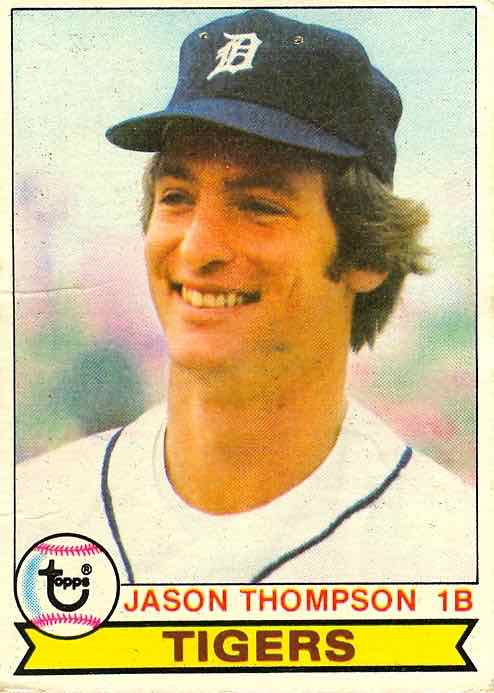
The Hollywood native joined the Tigers full time in 1976 and played 123 games that year, hitting .218, with 17 home runs and 54 RBI. Two of the homers cleared the rightfield roof at Tiger Stadium. It was in 1977, though, that he made his mark: .270, 31 homers and 105 RBI — and earned an All Star Game selection.
The 1977 Tigers yearbook noted:
Jason led the Tigers with 31 home runs and 105 RBI — the first Tiger since Norm Cash (32) in 1971 to top 30 homers and the first since Willie Horton (100) in 1966 to attain the century mark in RBI.
At that point, the Tigers had to like their team of the future: Thompson, Lou Whitaker, Alan Trammell, Lance Parrish, Steve Kemp, Ron LeFlore, Jack Morris, et al, with a third baseman to be named later.
Thompson had another solid year in ’78, hitting .287 with 26 homers and 96 RBI.
The Beginning of the End in Detroit … Already?!
In 1979 he continued to hit homers and drive in runs — 20 and 79, respectively — but his average dropped 40 points to .246. That was also the year that Sparky Anderson arrived and, so the story goes, Thompson and Sparky didn’t mesh.
In 1980, Thompson got off to a slow start: .214/4/20 in 36 games, and Sparky invoked his My Way or the Highway clause and sent his first baseman to Orange County.
As I’ve said before, Thompson’s replacement, Richie Hebner, was a favorite of mine too. But, who were the Tigers kidding? Hebner over Jason Thompson?
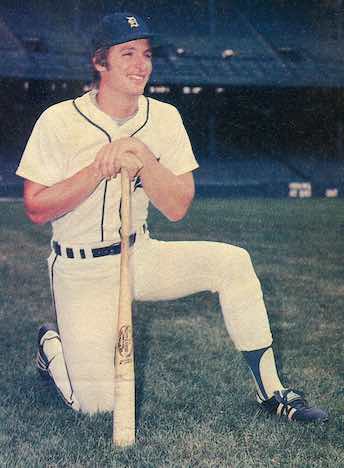
From Anaheim to Pittsburgh to Montreal
Back home in southern California, Thompson thrived. In 102 games he batted .317 with 17 homers and 70 RBI. (Hebner hit .290/12/82.) On the eve of the 1981 season the Angels traded the three-time All Star to the Pirates for Ed Ott and Mickey Mahler.
In his five seasons in Pittsburgh, Thompson hit 93 home runs and averaged 93 RBI (not counting the 42 in the shortened ’81 season).
On April 4, 1986, the Pirates traded him to the Montreal Expos for players to be named later. Thompson played only 30 games for the Expos, hitting .196 with no home runs and just four RBI. On June 30, at the age of 31 and with balky knees, Jason Thompson was out of baseball for good.
The Jason Thompson Curse
If you remove the years that Darrell Evans and Cecil Fielder manned first base, the Tigers have had a revolving door at the position since they traded Jason Thompson. I call it The Curse of Jason Thompson: Hebner, Enos Cabell, Dave Engle, Keith Moreland, Tony Clark, Eric Munson, Carlos Pena, Chris Shelton, Sean Casey and Carlos Guillen. (And now, of course, Miguel Cabrera. Though I’m not convinced he’s long for first base.)
When looking back on the 1984 World Series team, I often think about how that team, or three-quarters of the starting nine, could’ve been homegrown talent — if Thompson were still in Detroit then.
With the exception of Chet Lemon and Larry Herndon, the Tigers could’ve had six of eight starters developed from Lakeland on up. (Or seven of nine if Morris or Dan Petry were on the hill.) Quite a different scenario from the 2008 Tigers when only two full-time, homegrown position players — Curtis Granderson and Matt Joyce — roam the field.
Today Thompson runs “Jason Thompson Baseball” in Auburn Hills, where kids can get hitting and fielding instruction from old #30 himself. He’s also an executive with Wachovia Securities.
If you can’t tell, even 28 years later I’ve still not gotten over the trade involving my favorite childhood player. I quickly hitched my wagon onto Hebner as a way to ease the pain. But that didn’t last long either, come to think of it.
So I threw my allegiance behind Kirk Gibson and five years later, when Gibson signed with the Dodgers, had to deal with the anguish all over again.

…When, on May 14, we failed to acknowledge the 57th birthday of former Tigers infielder Stan Papi.
The Tigers purchased Papi’s contract from the Phillies on May 29, 1980 and he made an immediate splash in Detroit.
On Friday, May 30 against the Angels, Papi started at second base and batted ninth (behind the number-eight hitter, Kirk Gibson).
He struck out against Frank Tanana in the bottom of the second but in the fourth smacked a two-run home run of Tanana to give the Tigers and Milt Wilcox a 4-1 lead. He singled in his next at bat and then tripled in the sixth off Jim Barr. The Tigers won the game 12-1.
Papi finished the 1980 campaign with a .237 average, three homers and 17 RBI in 46 games. He hung around for 40 games in the strike-shortened 1981 season, hitting just .204.
His last appearance in a big-league game came on Oct. 1, against the Orioles at Tiger Stadium. Sparky inserted him as a pinch hitter for Rick Leach in the seventh; Papi struck out against Tippy Martinez to end the inning.

 dailyfungoarchive.com