
25 Years Later: Milt Wilcox’s Near-Perfect Game

I remember it clearly: April 15, 1983.

It was a freezing cold day in Detroit just like it was at Comiskey Park. Making matters worse, the Tigers and White Sox were playing at night. (Imagine last Friday night’s game in Chicago — only colder and without the precipitation.)

The Tigers’ Milt Wilcox pitched the game of his life against the White Sox’s pot-smoking and eventual Cy Young Award-winning LaMar Hoyt (or according to Baseball-Reference.com, “La Marr Hoyt”). And to this day, it was the most meticulously pitched game I’ve ever seen … though Mike Mussina‘s near-perfecto against Boston in 2001 was darned close.

Twenty six Chicago batters up, 26 down. More on that in a moment.
According to Retrosheet.org, here is Detroit’s lineup from that night:

  1. Lou Whitaker 2b
  2. Howard Johnson 3b
  3. Larry Herndon lf
  4. Lance Parrish c
  5. John Grubb dh
  6. Glenn Wilson rf
  7. Chet Lemon cf
  8. Rick Leach 1b
  9. Alan Trammell ssWilcox p

And, the White Sox’s:

  1. Rudy Law cf
  2. Tony Bernazard 2b
  3. Harold Baines rf
  4. Greg Luzinski dh
  5. Ron Kittle lf
  6. Greg Walker 1b
  7. Carlton Fisk c
  8. Vance Law 3b
  9. Jerry Dybzinski ss
  10. LaMar Hoyt p

For me, there are many fascinating things about the Tigers’ lineup that night — Howard Johnson batting second and playing third base, Glenn Wilson in right, Rick Leach at first — but none more fascinating than Alan Trammell hitting ninth.

 True, he often hit in the nine-hole early in his career. But 1983 was a particularly interesting year for Trammell, who batted primarily ninth during the first half of the season, though occasionally Sparky slotted him at number-two or, less frequently, leadoff. But from Aug. 20 on, Tram never hit below the number-two spot.

The story on this night 25 years ago was Milt Wilcox.

Wilcox’s Road to the Majors

The Honolulu native was drafted by Cincinnati in the second round of the 1968 amateur draft. He debuted with the Sparky Anderson-managed Reds in 1970 at the age of 20, posting a 3-1 record and a 2.42 ERA.

Sparky would earn a reputation for having little tolerance for youngsters on his team. Apparently he didn’t feel that way in 1970 because he pitched Wilcox in the NLCS and World Series that year. He struck out five in just three innings of the LCS against the Pirates allowing only one hit.

The Orioles fared a tad better against Wilcox in the World Series. In two appearances (just two innings pitched), he allowed three hits, two earned runs, two walks and a pair of strikeouts.

After the 1971 season, Wilcox was traded from the Reds to Cleveland for outfielder Ted Uhlaender. After three mostly forgettable seasons with the Indians, he was dealt to the Cubs for pitcher Dave LaRoche and outfielder Brock Davis. Wilcox appeared in only 25 games for the Cubs in 1975 and spent the Bicentennial Year in the bushes.

Welcome to Detroit

On June 10, 1976, the Tigers purchased his contract from the Cubs and his career began to stabilize. From 1977-84, Wilcox was a mainstay in the Tigers’ rotation, averaging 22 starts and nearly eight complete games a year.
Wilcox_Milt78

But none of his 72 other complete games could compare to the frigid night on the South Side.

26 Down…

Wilcox, wearing number 39, cruised through the first 26 batters with only a couple minor scares — a Tony Bernazard dribbler up the middle in the first that Trammell turned into an out and then a Harold Baines low liner to Herndon in the bottom of the seventh.

In the bottom of the ninth, Carlton Fisk flied out to left on the first pitch. Then Mike Squires, a Western Michigan University product, pinch-hit for Vance Law and promptly grounded out to Leach at first.

Chicago manager Tony LaRussa replaced Jerry Dybzynski with another Jerry, Jerry Hairston

On Wilcox’s first pitch, Hairston grounded a single to center for Chicago’s only baserunner of the night. (And I can still hear George Kell crying out: “Wouldya believe it!“)

The next hitter, Rudy Law, bounced out to Leach to end the game. The Tigers won 6-0, but Wilcox lost a chance at the Hall of Fame.

Here’s what Wilcox told the Free Press‘s Mike Downey:

“I was nervous the whole game,” Wilcox said later. “Pitching a perfect game puts you in the Hall of Fame. That’s the only way I’m going to get there.”

Here’s the final pitching line that night:

Wilcox: 9 IP – 1 H – 0 R – 0 ER – 0 BB – 8 SO – 0 HR

Less than a year later, in the same park and in similar conditions, Jack Morris would throw his no-hitter; perhaps using the leftover karma from Wilcox’s gem.

Though officially it was Hairston’s single that broke up the perfect game, perhaps there was some friendly fire jinxing going on in the Tigers dugout.

Again from Downey’s column:

“I heard them talking about it on the radio,” Wilcox said, and “(Kirk) Gibson said something to me in the fifth inning. I wasn’t worrying about being jinxed. I was worried about finishing the game.”

So much for Gibson following tradition.

Winding Down a Career

Wilcox would finish the 1983 season with a 11-10 record and a 3.97 ERA. His highest win total would come the next year when he finished at 17-8, 4.00 ERA.

His last season in Detroit was an abbreviated one. Arm trouble caused him to shutdown with a 1-3 record and a 4.85 ERA in 1985. The Tigers released him on Dec. 20 that year.

The Mariners signed Wilcox on Feb. 5, 1986. He appeared in 13 games for Seattle that season before being released on June 14 with a 0-8 record and a 5.50 ERA.

In 1984, Wilcox won a game in the ALCS and the World Series (I attended both games). But for most Tigers fans, his defining moment will be his flirtation with a perfect game a quarter-century ago.

The 1984 Hernandez/Bergman Trade Revisited

In case you’d forgotten, it was 24 years ago this week that the Tigers swung a deal with the Phillies that changed the 1984 season for the Tigers dramatically — and instantly.

On March 27, 1984, the Tigers acquired lefty reliever Willie Hernandez and first baseman Dave Bergman from Philadelphia in exchange for OF Glenn Wilson (my favorite Tiger back then) and all-purpose guy John Wockenfuss.

With World Series expectations higher than perhaps ever in Tigers history and the team searching, as it was in 1984, for bullpen reinforcements, let’s look back on a trade for the ages.


Willie

There was no reason to expect the moon from Willie Hernandez as the Tigers’ new closer. After his trade to the Phillies from the Cubs on May 22, 1983, he went 8-4 with a 3.29 ERA and seven saves in 63 appearances, primarily as a setup man for closer Al Holland.

But, as if I need to remind you, in 1984 Hernandez put together the career year to end career years: 9-3, 32 saves, 1.92 ERA, 80 appearances, 140 IP, All Star, American League Cy Young Award winner and Most Valuable Player.

Sparky had lots to say about Willie Hernandez in his book about the ’84 season, Bless You Boys. Here’s some of it:

I’ve been in baseball for 31 years, and there’s no way I can believe what I saw in Willie Hernandez this year.

Don’t ask me to explain Willie. How do you explain a miracle? Every time Willie had a chance for a save, Willie got it. Every time we desperately had to have a win, Willie was there. When I read that Hernandez didn’t pitch in 82 of the Tigers regular-season games in 1984, I find it hard to fathom. As a kid it seemed as if he pitched every day. And as Sparky said, when he did pitch, good things usually happened.

Thanks to his miracle season, Hernandez, who wore number 21, cashed-in on a big contract extension with the Tigers and, at age 29, appeared to be the closer for the long term.

In 1985, he turned in a decent year, though spoiled-rotten Tigers fans took to booing Hernandez regularly. He had an astonishing 18 decisions (8-10) even though he compiled stats that current Detroit fans would love to see from Todd Jones: 31 saves, 2.70 ERA.

From 1986 until his final year in Detroit in 1989, Hernandez’s save totals fell from 24 to 8 then bumped up to 10 and 15. Meanwhile his ERA headed north rapidly, topping out at 5.74 in ’89 — when the entire franchise bottomed out.

The Tigers released him on Dec. 20, 1989. He never appeared in another major-league game. All told, Willie Hernandez finished his Tigers career with a 36-31 record, 120 saves and a 3.44 ERA.


Bergie

Dave Bergman was traded twice on March 24, 1984. The first deal sent him from the Giants to the Phillies for Alejandro Sanchez. (Interestingly, almost a year later, the Tigers sent Roger Mason to San Francisco for Sanchez) The Phillies quickly spun-off Bergman to Detroit. Most thought he would replace Wockenfuss as a part-time first baseman and outfielder. In reality, he became a workhorse defensive replacement for newly acquired Darrell Evans at first base.

In 1984, Bergman made a quick impact with his glove and, as the season wore on, with some clutch, late-inning heroics.

In the bottom half of the eighth inning at Comiskey Park on April 7, Sparky put Bergman in at first base as a defensive replacement for Barbaro Garbey. The White Sox’ Jerry Hairston ripped a groundball down the first-base line. Bergman, playing close to the line, slid to his left and snuffed the grounder for the first out of the inning but more importantly, protected Jack Morris‘s no-hitter.

(Nearly a year earlier, Hairston crushed Milt Wilcox‘s bid for a perfect game with two outs in the bottom of the ninth. That’s what we call karma.)

On June 4 in Detroit against the Blue Jays, Bergman had what Sparky called the greatest at bat he’d seen in his life. Let’s allow Captain Hook describe it, again from the pages of Bless You Boys:

Here’s the scene: Two out in the last of the tenth, two men on, and the score tied at 3-3. Reliever Roy Lee Howell (sic) pitched to a full count. Then Bergie took over. Bergie fouled off seven pitches and then picked one practically off the ground and drilled it into the upper deck in right.What a battle! Bergie was up there a full seven minutes. It seemed like a whole season. The house went wild.

Actually, Bergman’s homer came off Roy Lee Jackson, which surprised me because I thought it was Luis Leal.

What made that game so much fun was that it was the season opener for ABC’s Monday Night Baseball, which was much bigger back then than ESPN’s Wednesday or Sunday night games are today. Also, school was almost out for summer and my friends and I were fired up for lots of excursions to Tiger Stadium’s bleachers.

During the 1984 season, Bergman appeared in 120 games, 114 at first base and one each in right and left field. He finished the year with a .273 average, seven home runs and 44 RBI. Defensively, Bergman made just eight errors in 732 chances, a .989 fielding percentage.

Wearing Wockenfuss’s number 14, Bergman became a mainstay with the Tigers. In nine seasons in Detroit he batted .252 with 39 home runs and 219 RBI. He retired after the 1992 season but remained in metro Detroit working in financial services.

Looking at the trade nearly a quarter century later, Detroit undoubtedly benefited the most. The Tigers got six seasons of work from Hernandez and nearly a decade from Bergman. Though the Phillies got barely a season and a half from Wockenfuss (whom we profiled here), Wilson had three respectable seasons in Philadelphia. In 1985, he batted .274 with 14 home runs and 102. The next season, he batted .271, 15 homers and 84 RBI.

Still, chances are only the most-diehard Phillies fan could point out any impression Wilson or Wockenfuss made on those mid-1980s Philadelphia teams. Tigers fans, however, remember vividly the contributions of Willie Hernandez and Dave Bergman.

Remember Rich Monteleone?

Before the names of Kyle Sleeth, Kenny Baugh, Justin Thompson and even Scott Aldred and Steve Searcy evoked images of a star-studded starting rotation for the Tigers, there was one name the personified unfulfilled promise for Tiger fans: Rich Monteleone. (Actually, Monteleone and 1981 first-rounder Ricky Barlow led this category in the early ’80s, but we’ll focus on Monteleone who celebrates his 45th birthday today. Ironically, Barlow’s 45th was yesterday.)

Anyone who’s followed the Tigers at least since the late 1970s likely remembers the name. Detroit’s first-round pick in the 1982 amateur draft (#20), Monteleone, we were told, would slide into the rotation behind Dan Petry and someday become the Tigers’ ace.

So we waited. And waited.

Continue reading “Remember Rich Monteleone?”

Happy Birthday, Fernando Arroyo

FernandoArroyo.jpgIf you spend time looking through old Tigers yearbooks, especially those from the 1970s, and you have no recollection of the barren period of Tigers baseball, you might think those teams were this close to pennant contention.

As if.

The descriptions of the players in the yearbook are deftly crafted. Take, for example, Chuck Scrivener [emphasis is mine]:

Chuck bounced around the Tiger farm system for seven years before getting his first chance, low plate figures holding him back. But he broke loose with a .251 average at Evansville in 1975 to help lead the Triplets to the Junior World Series title.

Hmm. Batting .251 in Triple-A is considered “breaking loose”? Those were lean times for Detroit.

Another name you’ll find in the Tigers yearbooks of that era is Fernando Arroyo, who just so happens to turn 56 today.

In 1975, Arroyo appeared in 14 games and earned a 2-1 record, with a 4.58 ERA. The Sacramento native spent all of the ’76 campaign in Evansville before returning to Detroit in 1977. In 38 games that year his record was 8-18 with a 4.18 ERA.

Here’s what the yearbook had to say about that ’77 campaign:

Fernando had lost 18 games — but six were by one run and 12 came when the Tigers failed to score, scored once or scored twice. That’s not the kind of support to enhance a pitcher’s record.

In 1978 and ’79, Arroyo — who wore number 36 — pitched a mere 16 innings in eight games for Detroit compiling a 1-1 record.

On Dec. 5, 1979, he was traded to the Minnesota Twins for Jeff Holly. He spent parts of three seasons with the Twins before being released. Arroyo pitched in the White Sox organization from 1982-84.

Almost two years later, he reappeared in the big leagues, this time with Oakland. On Monday, Aug. 11, 1986, Arroyo came into a 4-4 game in the top of the ninth against the Mariners with two out, Danny Tartabull at first and Ken Phelps at second.

He walked the first batter he faced, Bob Kearney, to load the bases. Next he walked Spike Owen to bring home Phelps and the go-ahead run. Then he walked Domingo Ramos, plating Tartabull and giving the Mariners a 6-4 lead. Dave Leiper replaced Arroyo and got Harold Reynolds to flyout to center to end the inning.

And that was the last we heard of Fernando Arroyo.

Uncovering Tigers Treasures…in Arizona

TheDetroitTigersBookCover.jpgSo there I was the other day, browsing the shelves at my in-laws’ community library where all books are donated by residents. (I often donate books too and was looking for one that I thought I’d mistakenly donated, “Ted Williams’ Hit List“.)

Instead of “Hit List” I found a treasure on the give-away shelf: An original, hardcover edition (with dust jacket!) of The Detroit Tigers by Frederick G. Lieb, published in 1946.

My first question was “Who is Frederick Lieb?” (Actually, my first question was “Who in their right mind didn’t want this book?!”)

Well, it just so happens that Lieb is one prolific baseball writer who penned many baseball books including The St. Louis Cardinals, The Baltimore Orioles, and Connie Mack. Do an Amazon search for him and get a load of all he works produced.

Though I haven’t dug into the book yet, a quick review offers a taste of the language used in 1940s sportswriting. Take, for example, this snippet from the jacket flap:

High or low in the standings, the Detroit Tigers have always been a fighting baseball club, snarling and scrapping to the finish. From the time of Watkins’ famous Detroits of the early National League, who in 1887 defeated the St. Louis Browns in a circus 15-game World Series, to Steve O’Neill’s Tiger Kings of 1945 everything has happened in Detroit baseball — except a tailender.

Admittedly, I needed to lookup “tailender” to see what the word meant in this context. According to Merriam-Webster OnLine a tailender is one positioned at the end or in last place, “the tailenders in a race”. Now I know.

And then there’s this, also from the jacket flap:

Fred Lieb … tells the dramatic and exciting story of the Detroit Tigers, a ball club that has never known how to quit, one that has always held the threat of exploding a rally and going on to win when the chips were down. Win or lose, the Tigers have always been a spirited club.

I did some noodling around online and discovered that a new paperback edition of the book will be published in July by Kent State University Press. The book will include a new foreword by author and Tigers Podcast guest, Tom Stanton. Check it out.

And then I found this!

GreenbergTrade.jpgIf stumbling onto a rare Tigers book weren’t enough, I found an unexpected bonus tucked inside: a tattered and yellowed copy of The Detroit News sports page dated Sunday, January 19, 1947.
The main headline read “12,656 Watch Notre Dame Top U.-D.”, but the story of the day was the reaction to Hank Greenberg‘s contract being sold to the Pittsburgh Pirates for $75,000. (Oh, and the Wings lost to the Maple Leafs 7-4 in Toronto.)

Sports writer Paul Chandler wrote a piece titled “What the Fans Say About Frank’s Going” and it’s filled with gems such as this one from telephone operator Vivian Rigg:

They can’t do that. He’s our star player — the only one I recognize. He draws the crowds. Pittsburgh, of all places!”

And this from Detroit policeman John Prakes, who should’ve received a call from central casting for “Dragnet“:

I won’t kid. Greenberg was my favorite ball player. There’s that sergeant down at the station. All he talks about is Hank. Wow! Wait’ll I tell him. He’ll burn for a week.”

The rest of the cluttered page contains small stories related to the trade, including:

  • (Hal) Newhouser Regrets Deal: “Hank’s a great guy, and it’s tough to see him leave with that big bat of his,” Newhouser told the Associated Press.
  • (Pirates manager Billy) Herman Ponders Greenberg’s Job: “I’m pretty sure we’ll use Hank in the outfield,” Herman said.

Greenberg played only one season in Pittsburgh before calling it quits at 36. Though he finished 1947 with a .249 average — his lowest by 20 points — Hank still hit 25 homers, drove in 74 and led the National League with 104 walks. Of course, his final career line is flat-out stunning: .313 average, 331 home runs, 1,276 RBI, two MVP awards and five All Star Game appearances over 12 seasons.

Before I found these two items I didn’t frequent this particular library very often. But with luck like this, I may become a regular.

Happy Birthday, Johnny B.

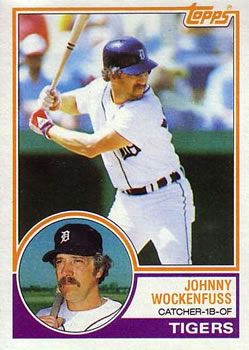
The first time my brother imitated the finger-waving batting stance of a Tigers player by the name of “Wockenfuss” I was convinced he made it up.

Not only did the name sound like a cartoon character, the flapping of the right hand on the bat was too much for my nine-year-old brain to process as a viable approach at the plate.

I soon learned that Johnny Bilton Wockenfuss was – and is – a real-life person.

Never a superstar, he was a Super Sub before the phrase existed. He played key roles for the Tigers and helped the club bridge the gap between emerging contender and World Series Champion.

‘Fuss was drafted by the Washington Senators in the 42nd round of the 1967 amateur draft. His road to Detroit wound through Arlington, Texas, after the Senators relocated following the 1971 season.

On June 6, 1973 he was traded by the Rangers with Mike Nagy to the Cardinals for Jim Bibby. Less than six months later – on Dec. 3 – St. Louis sent him to the Tigers for minor-leaguer Larry Elliott.

Ironically, Wockenfuss made his major league debut on Aug. 11, 1974 against the Rangers at Arlington Stadium – and faced the pitcher he was traded for a year earlier, Bibby.

He started at catcher, as he would 12 more times that season, and, batting ninth, went 0 for 2 with a walk. In his first big-league at bat (leading off the Tigers third) he popped out to shortstop Toby Harrah.

Wockenfuss’s first major league hit would come three days later at Tiger Stadium off Royals starter Steve Busby — an RBI single with two outs in the ninth (Jim Nettles, brother of Graig scored).

During the lean years of the mid-1970s, Johnny B. – wearing first #45 and then, from 1976 on, #14 – steadily gained playing time, primarily behind the plate for manager Ralph Houk. When Sparky Anderson was hired in 1979, ‘Fuss became more of a first baseman/outfielder/DH hybrid.

For the next four seasons, Wockenfuss had a .265 average. His best year at the plate for Detroit was in 1982 when hit batted .301 in 79 games.

In the spring of 1984, the buzz around Lakeland was of a team poised to make the leap to the postseason. Wockenfuss had been so valuable to the Tigers over his 10 seasons that no one suspected he wouldn’t be with Detroit on Opening Day.

But on March 24, 1984, roughly one week before the Tigers opened the season in Minnesota, ‘Fuss was traded with outfielder Glenn Wilson to the Phillies for Willie Hernandez and Dave Bergman.

We know how that played out.

In Philadelphia that year, Wockenfuss played in 86 games, mostly at first base, batting .289. In 1985, he appeared in just 32 games, collecting six hits. When the Phillies released him on Aug. 19, 1985 – almost 11 years to the day of his debut – his career was over.

Two years later, though, he was back in the Tigers organization as the manager of Lakeland in the Florida State League. He appeared to be on a meteoric rise in the organization. In 1988 he led the Glens Falls Tigers of the Eastern League two a first-place finish. The next season he was promoted to manager of Toledo where the Mud Hens finished in sixth place. He lasted only 24 games of the 1990 season before he was fired on April 29.

And that was all she wrote for Johnny B. Wockenfuss as a member of the Tigers family.

I remember feeling bad in 1984 that Johnny B. wasn’t around to enjoy the Tigers World Series championship. Years later when the Pistons won their first NBA Title they had some of the old guard on hand for the celebration. Too bad Wockenfuss couldn’t have participated in a similar sort of revelry in October ’84.

Raise a glass today for Johnny B. Wockenfuss. He’s 59.

Happy Birthday, Jerry Morales

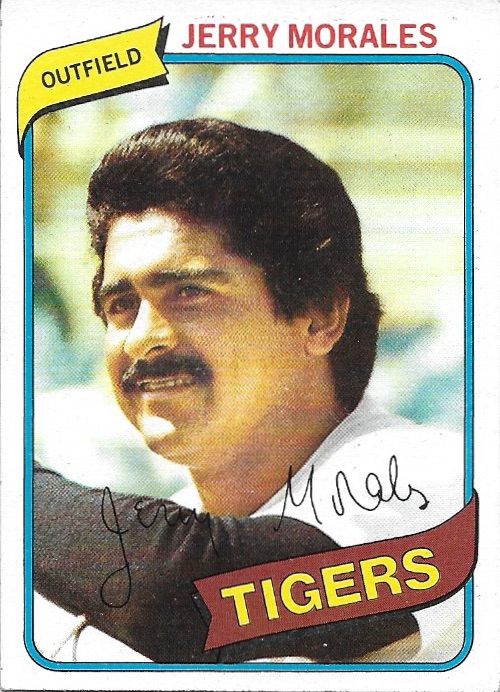
Happy Birthday to former Tigers outfielder Jerry Morales. He was acquired, along with Aurelio Lopez, from the Cardinals for Bob Sykes and Jack Murphy. Not sure if Jim Campbell saw Señor Smoke as the key to the trade but he certainly made the deal worthwhile.

Morales, wearing #27, played in 129 games in 1979, most of them in right field. His hefty combo of a .211 average and .260 OBP helped make his stay in Detroit a short one.

On October 31, 1979, he was traded with Phil Mankowski to the New York Mets for offseason grave digger Richie Hebner.

As much as I loved Hebner, the last Tiger to wear Charlie Gehringer‘s #2 before it was retired, I can’t believe he was two-for-one trade material.

Feliz cumpleanos, Jerry.

Tiger Stadium Seats, Continued

On Oct. 17 of last year I wrote about the arrival of my Tiger Stadium seats. Since then we’ve received almost three dozen comments from Tigers fans in the Detroit area and beyond in which they talk about everything from the condition of the seats when they arrived (almost universally dirty) to finding blue paint for touch ups to where the owner will place the seats.

If you’ve received your seats and have questions about anything from paint to brackets, visit the post here and browse the comments.

Kemp for Lemon Revisited

Twenty six years ago today the Detroit Tigers traded left fielder Steve Kemp to the White Sox for Chet Lemon. It was the quintessential Jim Campbell Winter Meetings trade.

Kemp made too much money and former GM Campbell didn’t like players who held out (Rusty Staub) or won in arbitration (Kemp, again). Campbell also liked to trade players who, like Kemp and Ron LeFlore in 1979, were entering their walk year.

On Nov. 27, 1981, the Tigers and White Sox swapped outfielders both who were former top selections in the amateur draft (Lemon by Oakland in 1972, Kemp number-one overall by Detroit in 1976), were roughly the same age and who had put together similar careers to that point.

While many Tigers fans might remember Lemon as an All-Star centerfielder who hit sixth or seventh in Sparky‘s lineup, in his first season in Detroit he batted leadoff 49 times and played 93 games right field. (By early July, Lou Whitaker took over the leadoff spot for good.) It wasn’t until 1983 that he switched positions with Kirk Gibson and became the regular centerfielder…until Gary Pettis arrived in 1988. Lemon finished his first season as a Tiger with a .266 average, 19 HR and just 52 RBI in 125 games.

Lemon hit 142 homers for the Tigers in his nine seasons in Detroit and proved to be a rather durable player averaging 134 games played over that span. (Note: There’s no record of the number of rallies Lemon killed in Detroit but would it be far-fetched to think the total to be in the triple digits?)

Steve Kemp was no slouch during his five years patrolling left field at Tiger Stadium. He produced a .284 average, 89 home runs (lowered a bit with his nine homers in the strike-shortened 1981 season), and averaged 84 RBI and 23 doubles. He also displayed a keen eye at the plate averaging 75 walks — including 97 in 1978.

In his only season in Chicago, Kemp had a career year batting .286 with 19 HR and 98 RBI in 160 games. As I noted, Lemon also hit 19 home runs in 1982 but drove in nearly half the number of runs.

After the ’82 season Kemp cashed in on a free-agent contract with the New York Yankees but he, like so many other mid-’80s free agents, flopped in the Bronx. In 1983, Kemp hit .241 with just 12 home runs in 109 games. After the ’84 season he was traded with Tim Foli and cash to the Pittsburgh Pirates for Dale Berra, Alfonso Pulido and Jay Buhner.

An eye injury, suffered when Kemp was hit by a batted ball in batting practice, shortened his career in the mid-1980s. He last played in the majors in 1988 when he played in 16 games for the Texas Rangers, hitting just .222 in 36 at bats. His career batting average in 11 seasons was .278 — five points higher than Lemon’s.

When Jim Campbell pulled the trigger on the Kemp-for-Lemon deal he probably had no idea that Kemp would flame out and that Chet the Jet would play more than 1,100 games in the outfield for Detroit.

Still, he had to like the odds that the trade would work out better than LeFlore for Dan Schatzeder.

As frustrating a player as Chester Earl Lemon could be, he was nothing if not reliable during some fun summers for Tigers fans.

Tram a World Series All-Star

This morning Rob Neyer posted a fun column on ESPN.com this morning in which he asks:

If you were going to put together an all-World Series team, who would you choose?

God love Rob Neyer for selecting Alan Trammell at shortstop. Neyer admits that there aren’t a lot of breakthrough performances by shortstops in the World Series but nevertheless, Tram’s 1984 numbers (.450 in the Series) standout above names including Phil Rizzuto and Derek Jeter.Now if we can just get Trammell into the Hall of Fame.