
Archives

Randy Smith’s Losing Bet

Nine years ago today the Tigers swung a blockbuster trade for the ages — one Tigers fans are trying to forget.

On Nov. 2, 1999, the Rangers sent outfielder Juan Gonzalez, pitcher Danny Patterson and catcher Gregg Zaun to the Tigers for pitchers Justin Thompson, Alan Webb and Francisco Cordero, outfielder Gabe Kapler, catcher Bill Haselman, and infielder Frank Catalanotto.

Sound like a ripoff? That’s not the half of it.

Let’s take a trip down memory lane and see how that worked out for both teams since the day of the trade:

Detroit

Gonzalez

  • 2000 (Detroit): 115 G, .289, 22 HR, 67 RBI
  • 2001-05 (CLE, TEX, KC): .302, 72 HR, 262 RBI

Zaun

He never played in Detroit. On March 7, 2000, the Tigers sent him to the Royals as part of a conditional deal. Think the Tigers could’ve used him behind the plate during those pre-Pudge seasons? Me too.

  • 2000-2008 (KC, HOU, COL, TOR): .254, 62 HR, 336 RBI

Patterson

  • 2000-04 (Detroit): 10-11, 6.17 ERA*, 5 saves (*Bloated by a 15.00 ERA in just three innings pitched in 2002. Without it, his Detroit ERA would be 3.97.)

Texas

Thompson

Poor J.T. He never could rebound from shoulder injuries that began to plague him in Detroit. He didn’t pitch in Texas until 2005 when he appeared in two games, surrendered four earned runs and two homers. He signed with the Brewers after that season and retired on June 20, 2006.

  • Career line: Five seasons, 36-43, 4.02 ERA, 428 K

Webb: According to Baseball-Reference.com, Webb never appeared in the majors.

Cordero: 2000-08 (TEX, MIL, CIN): 31-31, 211 saves, 4.00 ERA

Kapler: 2000-06, ’08 (TEX, COL, BOS, MIL) .279, 54 HR, 291 RBI

Haselman: By the time of this trade, Haselman was nearing the end of his 13-year career. He broke in with the Rangers in 1990, played three seasons (’92-’94) with the Mariners, three with Boston, a return engagement with the Rangers, one year in Detroit, back to Texas, and then his final season in 2003 with the Red Sox. 2000-03 (TEX, BOS): .265, 12 HR, 69 RBI

Catalanotto : 2000-08 (TEX, TOR): .295, 66 HR, 384 RBI

From the moment I saw this trade announced on ESPN’s crawl I knew it was not going to work out well. How could it?

First, the Tigers were giving up far too much youth for essentially one player: Gonzalez who, on his best day, was a moody enigma.

Second, as Ian reminded me, then-GM Randy Smith was allegedly shaping the Comerica Park Tigers to be a pitching-defense-and-speed club.

Acquiring a plodding slugger doesn’t fit into that scheme — particularly when CoPa was dubbed Comerica National Park for its expansive dimensions.

And third, everything in the universe had to align with unrealistic precision for Gonzalez to even half-consider signing with the Tigers after the 2000 season.

It’s painful to see how the kids Detroit traded away blossomed in the Texas heat. Personally, the one player that hurt the most was Catalanatto. If ever a hitter were designed for Comerica Park, it was Cat.

Kapler could’ve been a good role player throughout this decade, Cordero could’ve been they type of closer the Tigers now seek via trade or free agency.

Coulda, shoulda, woulda. Perhaps those are the three words that best sum up this trade.

What do you think?

Kip Young, It’s Your Birthday

Happy 54th birthday to the pride of Bowling Green State University, Kip Young.
KipYoung.jpg
Young made his major-league debut on July 21, 1978 against the Angels at Tiger Stadium. He took the loss in the 11-inning game, surrendering two earned runs in the 11th. For the rest of the ’78 season Young (wearing number 44) was a starter, earning a 6-6 record — with seven complete games — and a 2.81 ERA.

In his sophomore season, Young, now wearing number 37, compiled a 2-2 record with a 6.39 ERA in 13 appearances, seven of them starts. Most notable in an otherwise unremarkable year, Young had a 2-to-1 strikeouts-to-walk ratio.

On Nov. 21, 1979, the Mariners purchased Young’s contract but he never pitched in a game for Seattle…or anyone else for that matter.

Other Tigers birthdays today include:

Remembering Dwight Lowry

Today would have been Dwight Lowry‘s 51st birthday. Fans old enough to remember Tigers baseball in the mid-1980s remember the tall gentle giant of a catching prospect.

Lowry_DwightLowry, an 11th-round pick in 1980, emerged from nowhere in Spring Training 1984 jumping from Double-A Birmingham to the big club as Lance Parrish‘s backup. As Sparky Anderson liked to do with new players, he got Lowry into action right away: as a seventh-inning defensive replacement for Parrish on Opening Day 1984 in Minneapolis.

Lowry was born Dwight Lowery and was 26 at the start of his rookie season. The 6′ 3″, 210-lb. left-handed hitter appeared in 32 games for the Tigers knocking 11 hits (two of them homers) in 45 at bats for a .244 average. His first major-league hit came on April 24 during the second game of a doubleheader against the Twins in Detroit: a single off Frank Viola in the seventh inning. The Tigers won the game 4-3 with the win going to Glenn Abbott. On May 20, he hit his first big-league homer off Oakland’s Lary Sorensen at Tiger Stadium. Sparky wrote about it in his 1984 diary Bless You Boys:

Dwight Lowry is a rookie catcher with us. He hit his first major league home run, so you know he’ll never forget May 20.

Lowry spent part of the season at Triple-A Evansville where he hit .220 in 61 games before being recalled by the Tigers in September.

In 1985, he spent the entire year with the Tigers’ new Triple-A affiliate, the Nashville Sounds. In 74 games he hit just .182. The next year he again split time with the Tigers and Triple-A. He appeared in 56 games in 1986 — the year Parrish hurt his back and was out after June — mostly at catcher but appeared in one game at each first base and rightfield. In the 1987 Tigers Yearbook the editors pointed out Lowry’s highlights from ’86:

Had three-run homer against Cleveland and hit .370 against the Indians; hit .500 against Kansas City and .389 against Toronto; against Oakland he hit .375 with eight RBI.

The ’87 season was Lowry’s last in Detroit. Appearing in 13 games, he hit .200.

Shortly after the Tigers were bounced from the ALCS by the Twins, Oct. 16, 1987, the Tigers released him. A week later those same Twins signed Lowry as a free agent. He went hitless in seven games for the 1988 Twins and played his final game on April 23, 1988.

His final major league stats: 108 games, 227 at bats, five home runs, 26 RBI and a .273 average.

According to Baseball-Reference.com, in 1989, Lowry played for the St. Petersburg Pelicans of the Senior Professional Baseball Association. He batted .245 in 43 games.

He returned to the Tigers organization in 1994 as manager of the Double-A Fayatteville Generals of the South Atlantic League. That season they finished in 10th place with a 62-75 record. The next season the Generals finished atop the Sallie League with a 86-55 record.

In ’96 the team finished fifth at 76-63 but won the second-half South Atlantic League Division Title. For his work with the Generals, Lowry was named the Detroit Tigers Player Development Man of the Year. In 1997, Lowry moved on to the Tigers’ New York-Penn League affiliate, the Jamestown (N.Y.) Jammers. Just 22 games into that season, on July 10, Lowry collapsed and died outside his Jamestown a short time after a 9-8 victory over the Batavia Clippers. According to the team’s GM Mike Ferguson, Lowry was taking out the trash when his wife heard him collapse. He was just 39 years old.

Shortly after Lowry’s death, the Tigers renamed their annual Player Development Man of the Year Award in his honor. Lowry is survived by his wife Pamela and children, Sesilie, Amanda and Zachary.

I remember reading about Lowry’s death and being really saddened by it. It was the first time a Tigers player that I’d watched in person — and particularly one from that 1984 club — had passed away. And at 39 it seemed even more cruel.

There are probably a number of people who’ve won the Lowry Award who never knew of him or saw him play. Let’s hope the Tigers make a point of telling these winners who Dwight Lowry was: a marginal major-league player who was helping shape a future generation of Tigers players.

Happy Birthday, Mike Chris

MikeChris.jpgRather than bore you with the minutiae of Mike Chris’s entire career, I thought I’d share some of the hyperbolic prose that can only be found in Tigers yearbooks from the 1970s and ’80s:

Mike Chris, the slender, youthful left-hander, created a sensation soon after arriving at Tiger Stadium from the Evansville farm club late in 1979. His very first effort was a start against the Royals and he made headlines by pitching six no-hit innings before needing help on the way to the first of his three victories for the season.

A Californian with good credentials, Mike was a No.1 draft choice in 1977 and lived up to his billing with a sizzling beginning at Lakeland, where he was 18-5 with a 2.01 ERA. For that, he was voted winner of the Win Clark Memorial Award, a trophy for products of Southern California won earlier by Steve Kemp.

In 13 appearances with the Tigers in 1979, eight of them starts, he finished 3-3 with a 6.92 ERA. He surrendered 30 runs — all of them earned. And that was it for his Tigers career.

On Dec. 9, 1981, he was traded by the Tigers with Dan Schatzeder to the Giants for Larry Herndon. That one worked out well for Detroit.

Chris pitched for the Giants in 1982 (0-2, 4.85) and ’83 (0-0, 8.10). At the end of the ’83 season he was selected off waivers by the Cubs but was released just before Opening Day 1984. Final line: 3-5, 6.43.

Happy 51st Birthday, Mike.

Happy Birthday, Matt Walbeck

10.jpgHe’s 39 today.

On Dec. 11, 1996, the Twins traded Walbeck (pictured with Carlos Pena and Matt Anderson) to the Tigers for minor leaguer Brent Stentz. Walbeck played for the Tigers in 1997 and wore number 8. In 47 games, he hit .277 with three home runs.

Then, on Nov. 20, 1997, the Tigers traded him with Phil Nevin to the Angels for minor leaguer Nick Skuse. Another terrific Randy Smith deal.

Fast-forward to March 22, 2002. He was sent back to the Tigers — from the Padres, of course — with Damian Jackson for Javier Cardona and minor leaguer Rich Gomez. This time he wore #45 and played in 27 games for the ’02 Tigers, batting .235 in 85 at-bats. He spent 21 games in the minors that year, hitting just .213.

His final year in Detroit — and in the bigs — was in 2003. In 138 games for the Tigers, and back to wearing number 8, he hit a career-low .174.

After his playing career, according to Walbeck’s Baseball-Reference.com Bullpen Page

In 2004, he became the manager of the West Michigan Whitecaps, a position he held until 2006. In both 2004 and 2006, the White Caps were league champions. 

In 2007 Walbeck was promoted to become the manager of the Erie SeaWolves, AA affiliate of the Detroit Tigers. With Walbeck at the helm, the SeaWolves improved from near the bottom of the Eastern League (Last place in 2006) to make their first playoff appearance since 2004. Walbeck was named the E.L. Manager of the Year.

In 2008 Walbeck will be the 3rd base coach for the Texas Rangers.

Earlier this week he was fired by the Rangers. Perhaps his birthday present is a new job in the Tigers organization? (Bullpen coach, anyone?)

Happy Birthday, Matt.

R.I.P. Eddie Brinkman

Brinkman.jpgSad news from Cincinnati today. Former Tigers shortstop Eddie Brinkman passed away at 66.

Brinkman joined the Tigers in 1971 as part of the trade that sent Denny McLain to the Washington Senators.

Brinkman won the Gold Glove in 1972, the same season he finished in the Top 10 for Most Valuable Player, and was named to the American League All-Star Team in 1973.

After his playing career, Brinkman was a coach and scout for the White Sox from 1983-2000.

Brinkman wore number 8 in his four seasons in Detroit. He never hit over .237 — an average the Tigers would welcome from Brandon Inge.

He epitomized good-glove-no-stick at shortstop and, according to my brother who watched him play, was a joy to watch.

Happy Birthday, Rob Deer

RobDeer.jpgIn two-and-a-half years with the Tigers (1991 through mid ’93), Rob Deer, #45 in your scorecard, hit 71 home runs and drove in 167 runs. He also struck out 426 times — that’s 37 percent of his 1,164 at bats.

Still, it was fun to watch him swing the bat with all his might every time up. And, oh, when he made contact…

Let’s wish Rob Deer a Happy 48th Birthday.

Remember Adam Pettyjohn?

He was rising star for the Tigers in the late 1990s and earlier this decade. He nearly lost his life due to ulcerative colitis and shortly after making a few appearances for the 2001 Tigers was out of baseball.
Well, Pettyjohn is back in the bigs with Cincinnati. He made his first appearance with the Reds right here in Phoenix on Sunday: 1 IP, 2 hits, 0 runs, 1 strikeout.

Check out this article by Rany Jazayerli on BaseballProspectus.com.

It’s a feel-good piece to be sure.

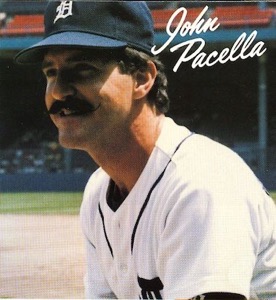
Happy Birthday, John Pacella

I’ll admit that while I remember John Pacella‘s cup of coffee with the Tigers in 1986 (11 innings pitched), I didn’t know much about him. But today I learned a lot about him, including:

  1. Today is Pacella’s 52nd birthday.
  2. The Brooklyn-born right-hander made his major-league debut on this date in 1977 — his 21st birthday — for his hometown Mets against the Phillies at Veterans Stadium in Philadelphia.

Pacella entered the game in the bottom of the seventh, relieving Rick Baldwin, and got the first hitter, Greg Luzinski, to line out to center. Next, Richie Hebner popped out to third. Garry Maddox doubled to right before Bob Boone popped out to Mets catcher John Stearns.

In his two innings of work, Pacella allowed a pair each of hits, walks and unearned runs. The loss went to Mets starter Craig Swan who allowed five walks in one inning of work.

All told, he pitched just four innings in 1977, didn’t pitch for the Mets in ’78, but returned in ’79 for 16 innings. In 1980, Pacella appeared in 32 games, 15 of them starts, and earned a 3-4 record.

Continue reading “Happy Birthday, John Pacella”