Archives

Today’s Tiger: Jason Thompson

Jason Thompson

  • Born: July 6, 1954 in Hollywood, Calif.
  • Bats: Left Throws: Left
  • Height: 6′ 4″ Weight: 200 lb.
  • Acquired: Drafted by the Tigers in the fourth round of the 1975 amateur draft.
  • Seasons in Detroit: 5 (1976-80)
  • Uniform Number: 30
  • Stats: .256 avg., 98 HR, 354 RBI, .779 OPS
  • Awards: Three-time All Star (1977, ’78 and ’82)

JasonThompson.jpg
On May 27, 1980, Tigers GM Jim Campbell traded my favorite player, first baseman Jason Thompson, to the California Angels for outfielder Al Cowens.

The Hollywood native joined the Tigers full time in 1976 and played 123 games that year, hitting .218, with 17 home runs and 54 RBI. Two of the homers cleared the rightfield roof at Tiger Stadium. It was in 1977, though, that he made his mark: .270, 31 homers and 105 RBI — and earned an All Star Game selection.

Continue reading “Today’s Tiger: Jason Thompson”

Today’s Tiger: George Cappuzello

George Cappuzello

  • Born: Jan. 15, 1954, in Youngstown, Ohio
  • Bats: Right Throws: Left
  • Height: 6′ 0″ Weight: 175 lb.
  • Acquired: Signed as a free agent on April 28, 1980.
  • Seasons in Detroit: 1 (1981)
  • Uniform Number: 41
  • Stats: 1-1, 3.48 ERA, 1 save

George Cappuzello, the man who allegedly was on an ice cream and doughnut diet during Spring Training in 1981, appeared in just 18 games that year for the Tigers.

Originally, Cappuzello was drafted by the Tigers in the 27th round of the 1972 amateur draft. He spent six seasons in the Tigers’ system before being traded with minor leaguer John Valle (minors) to the Reds for Jack Billingham on March 6, 1978. He returned to Detroit after being released by the Reds in April 1980.

After his March 1982 release from the Tigers, he appeared in 17 games for Astros, pitching in his final game on Aug. 5, 1982.

By the way, he turns 57 today.

Today’s Tiger: Morris Madden

Morris Madden

  • Born: Aug. 31, 1960 in Laurens, S.C.
  • Bats: Left Throws: Left
  • Height: 6′ 0″ Weight: 155 lb.
  • Acquired: Signed as a free agent on Nov. 23, 1985.
  • Seasons in Detroit: 1 (1987)
  • Uniform Number: 42
  • Stats: 0-0, 16.20 ERA, 1.2 IP

MorrisMadden.jpg

Don’t feel bad if you don’t remember Morris Madden‘s mini-career with the Tigers. He pitched just twice for Detroit during the 1987 season and one look at his stats tells you why.

On June 11 versus Milwaukee at Tiger Stadium, he came in during the sixth inning to relieve Eric King (who had relieved starter Jeff Robinson) with the bases loaded and promptly walked Brewers second baseman Jim Gantner. In his one inning of work, he allowed two earned runs and three walks. The Tigers lost the game 8-5.

Robinson’s next start, five days later at Toronto’s Exhibition Stadium, the lefty Madden came in to start the fifth inning. The first hitter he faced, Fred McGriff doubled to center, then Garth Iorg grounded out to Alan Trammell, advancing McGriff to third. Tony Fernandez singled, Lloyd Moseby flied out to center, then Jesse Barfield got an infield single. And that was the end of Morris Madden’s Tigers career.

Less than a month later, on Aug. 12, 1987, Madden was sent by the Tigers to the Pirates to complete the Aug. 7, 1987 trade of Darnell Coles for Jim Morrison.

If you’re wondering how he fared with Jim Leyland‘s Pirates, well it depends on the year. In 1988, he appeared in five games, allowed five hits and seven walks in five innings (!) but didn’t allow a run. In ’89, Madden pitched 14 innings across nine games — including three starts — he allowed a stunning 13 walks, 17 hits, 14 runs, 11 earned. Final ERA: 7.07.

On Nov. 21, 1989, he was released by the Pirates and while he pitched for the AAA Albuquerque Dukes in 1990, his major-league career was over.

Hall of Fame Leftovers

BaseballHallofFamelogo.pngSo after all the Hall of Fame ballots were counted, Tigers fans could only take solace in that Jack Morris saw his percentage of votes jump to 53.5 percent. That could bode well for the future but probably not next year.

Anyway, all the debates about whether Morris or Alan Trammell belong in Cooperstown got me wondering who the most-similar players are two these Tigers greats.

Thanks to the invaluable Baseball-Reference.com, we can get a quick look at how a player’s stats compare to others in baseball history.

I decided to look at how Baseball Reference compares Morris, Trammell and the BBWA-voter-shafted Lou Whitaker.

Continue reading “Hall of Fame Leftovers”

Today’s Tiger: Steve Kemp

Steve Kemp

  • Born: Aug. 7, 1954 in San Angelo, Texas
  • Bats: Left Throws: Left
  • Height: 6′ 0″ Weight: 195 lb.
  • Acquired: Drafted by the Tigers as the first overall pick of the 1976 amateur draft.
  • Seasons in Detroit: 5 (1977-81)
  • Uniform Number: 43, 33
  • Stats: .284 avg., 89 HR, 422 RBI, .826 OPS
  • Awards: All-Star 1979

When the Tigers traded left fielder Steve Kemp to the White Sox for Chet Lemon, it was the quintessential Jim Campbell Winter Meetings trade.

SteveKemp.jpg

Kemp made too much money and former GM Campbell didn’t like players who held out (Rusty Staub) or won in arbitration (Kemp, again). Campbell also liked to trade players who, like Kemp and Ron LeFlore in 1979, were entering their walk year.

Steve Kemp was terrific during his five years patrolling left field at Tiger Stadium.

He produced a .284 average, 89 home runs (lowered a bit with his nine homers in the strike-shortened 1981 season), and averaged 84 RBI and 23 doubles. He also displayed a keen eye at the plate averaging 75 walks — including 97 in 1978.

Continue reading “Today’s Tiger: Steve Kemp”

Today’s Tiger: Warren Morris

Warren Morris

  • Born: Jan. 11, 1974 in Alexandria, La.
  • Bats: Left Throws: Right
  • Height: 5′ 11″ Weight: 190 lb.
  • Acquired: Signed as a free agent by the Tigers Dec. 19, 2002.
  • Seasons in Detroit: 1 (97 games in 2003)
  • Uniform Number: 24
  • Stats: .272 avg., 6 home runs, 37 RBI, .689 OPS

If you keep trying to remove the memory of 2003 only to be reminded by, well, us, we’re about to hurt your effort a bit further. Today we’re looking back on infielder Warren Morris.

He played second base for the ’03 Tigers, hitting .272 in 97 games for that record-setting club. Four seasons earlier Morris finished third in the National League Rookie of the Year Award, hitting .288 with 15 homers, 73 RBI and a .787 OPS for the Pirates.

Three seasons before that, in 1996, Morris hit a ninth-inning College World Series Championship-winning home run against Miami. From Wikipedia:

LSU reached the championship game of the College World Series in 1996, and was trailing Miami 8–7 in the game with two outs in the bottom of the ninth inning. Morris came up to the plate with one runner on base, and hit Miami relief pitcher Robbie Morrison’s first pitch just inches over the right field fence. The walk-off home run won the game for the Tigers 9–8. It was his only home run of the season, and is the only walk-off championship-winning home run in College World Series history.

(Watch it here.)

Continue reading “Today’s Tiger: Warren Morris”

Today’s Tiger: Wayne Krenchicki

Wayne Krenchicki

  • Born: Sept. 17, 1954 in Trenton, N.J.
  • Bats: Left Throws: Right
  • Height: 6′ 1″ Weight: 180 lb.
  • Acquired: Traded by the Reds to the Tigers for Pat Underwood on June 30, 1983.
  • Seasons in Detroit: 1 (59 games in 1983)
  • Uniform Number: 15
  • Stats: .278 avg., 1 home run, 16 RBI

The summer of 1983 gave Tigers fans a glimpse of what was to come a year later: a young core of star players ready to move to the next level in the American League East. Detroit was in the race until September when the eventual World Series champion Orioles pulled away for good.

Krenchicki Wayne.That season also introduced fans — ever-so briefly — to a role player with one of the best names in baseball history: Wayne Krenchicki.

He came to the Tigers in a late-June trade with the Reds for once-promising lefty Pat Underwood. With Alan Trammell nursing injuries, the club needed some infield help.

As he always did with newly acquired players, manager Sparky Anderson put Krenchicki right to work, inserting him in the starting lineup against the Orioles and rookie Storm Davis.

On July 1, batting eighth in the lineup, Krenchicki went hitless in three at bats against Davis and the Tigers lost 9-5. He got his first Tigers hit two days later, a third-inning double off Tim Stoddard, in a 10-1 Tigers win.

In all, Krenchicki appeared in 59 games for the Tigers in 1983, seeing time at every infield position but played primarily at third. His time in Detroit was brief; in November that year, the Reds purchased his contract from the Tigers.

He finished his eight-year big-league career with the Reds and Expos, and retired after the 1986 season.

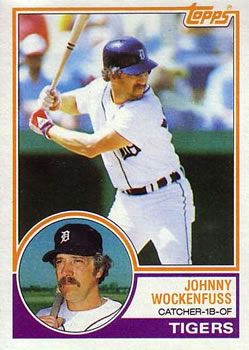
Today’s Tiger: Johnny Wockenfuss

Johnny Wockenfuss

  • Born: Feb. 27, 1949 in Welch, W. Va.
  • Bats: Right Throws: Right
  • Height: 6′ 0″ Weight: 190 lb.
  • Acquired: Traded by the Cardinals to the Tigers for minor leaguer Larry Elliott on Dec. 3, 1973.
  • Seasons in Detroit: 10 (1974-83)
  • Uniform Number: 45, 14
  • Stats: .261 avg., 80 HR, 284 RBI, .786 OPS

The first time my brother imitated the finger-waving batting stance of a Tigers player by the name of “Wockenfuss” I was convinced he made it up.

Not only did the name sound like a cartoon character, the flapping of the right hand on the bat was too much for my nine-year-old brain to process as a viable approach at the plate.

I soon learned that Johnny Bilton Wockenfuss was — and is — a real-life person.

Never a superstar, he was a Super Sub before the phrase existed. He played key roles for the Tigers and helped the club bridge the gap between emerging contender and World Series Champion.

‘Fuss was drafted by the Washington Senators in the 42nd round of the 1967 amateur draft. His road to Detroit wound through Arlington, Texas, after the Senators relocated following the 1971 season.

On June 6, 1973 he was traded by the Rangers with Mike Nagy to the Cardinals for Jim Bibby. Less than six months later — on Dec. 3 — St. Louis sent him to the Tigers for minor-leaguer Larry Elliott.

Ironically, Wockenfuss made his major league debut on Aug. 11, 1974 against the Rangers at Arlington Stadium — and faced the pitcher he was traded for a year earlier, Bibby.

He started at catcher, as he would 12 more times that season, and, batting ninth, went 0 for 2 with a walk. In his first big-league at bat (leading off the Tigers third) he popped out to shortstop Toby Harrah.

Wockenfuss’s first major league hit would come three days later at Tiger Stadium off Royals starter Steve Busby — an RBI single with two outs in the ninth (Jim Nettles, brother of Graig scored).

During the lean years of the mid-1970s, Johnny B. — wearing first #45 and then, from 1976 on, #14 — steadily gained playing time, primarily behind the plate for manager Ralph Houk. When Sparky Anderson was hired in 1979, ‘Fuss became more of a first baseman/outfielder/DH hybrid.

For the next four seasons, Wockenfuss had a .265 average. His best year at the plate for Detroit was in 1982 when hit batted .301 in 79 games.

In the spring of 1984, the buzz around Lakeland was of a team poised to make the leap to the postseason. Wockenfuss had been so valuable to the Tigers over his 10 seasons that no one suspected he wouldn’t be with Detroit on Opening Day.

But on March 24, 1984, roughly one week before the Tigers opened the season in Minnesota, ‘Fuss was traded with outfielder Glenn Wilson to the Phillies for Willie Hernandez and Dave Bergman.

We know how that played out.

In Philadelphia that year, Wockenfuss played in 86 games, mostly at first base, batting .289. In 1985, he appeared in just 32 games, collecting six hits. When the Phillies released him on Aug. 19, 1985 — almost 11 years to the day of his debut — his career was over.

Two years later, though, he was back in the Tigers organization as the manager of Lakeland in the Florida State League. He appeared to be on a meteoric rise in the organization. In 1988 he led the Glens Falls Tigers of the Eastern League two a first-place finish. The next season he was promoted to manager of Toledo where the Mud Hens finished in sixth place. He lasted only 24 games of the 1990 season before he was fired on April 29.

And that was all she wrote for Johnny B. Wockenfuss as a member of the Tigers family.

I remember feeling bad in 1984 that Johnny B. wasn’t around to enjoy the Tigers World Series championship. Years later when the Pistons won their first NBA Title they had some of the old guard on hand for the celebration. Too bad Wockenfuss couldn’t have participated in a similar sort of revelry in October ’84.

Today’s Tiger: Chris Brown

Chris Brown

  • Born: Aug. 15, 1961 in Jackson, Miss.
  • Died: Dec. 26, 2006 in Houston
  • Acquired: Traded by the Padres with Keith Moreland to the Tigers for Walt Terrell on Oct. 28, 1988.
  • Seasons in Detroit: 1 (1989)
  • Bats: Right Throws: Right
  • Height: 6′ Weight: 185 lb.
  • Uniform Number: 35
  • Stats: .193 avg., 0 HR, 4 RBI, .449 OPS

Perhaps no other word best describes third baseman Chris Brown like enigmatic.

After a promising start to his career with the Giants in 1985, his .271 average and 16 homers earned him a fourth-place finish in the National League Rookie of the Year Award, and an All-Star Game appearance in ’86, Brown began frustrating his managers and his teammates with a string of questionable and bizarre injuries. In fact, he never appeared in more games than he did that rookie season (131).

By the middle of the 1987 season Brown was shipped to the Padres with Keith Comstock, Mark Davis and Mark Grant for Dave Dravecky, Craig Lefferts and Kevin Mitchell. He didn’t fare well in San Diego either, hitting .232 in 44 games. In 1988 he hit just .235 in 80 games.

The Tigers were in complete freefall when they traded Walt Terrell to the Padres for Brown and Keith Moreland, whose best years were behind him. Why Detroit thought Brown and his “Tin Man” reputation would be transformed under Sparky Anderson is mystifying. His reputation for injuries — real or imagined — ranged from shoulder tenderness, a bad tooth and a sore eyelid. At least those are the more legendary ones — who knows if they were true.

In Detroit, the Chris Brown Experiment — such as it was — got off to a poor start when he arrived to spring training overweight. It ended after just 17 games, 11 hits and a .193 average. Worse yet, if possible, was a .909 fielding percentage in that time. On May 19, he was released. A few weeks later he was signed by the Pirates but never appeared in a big-league game for them.

He died in a mysterious Houston house fire on Dec. 26, 2006, at the age of 45. According to this MLB.com story:

Brown was employed by Halliburton Co. in Iraq, driving and repairing 18-wheel fuel trucks, and in a 2004 interview with The Associated Press, he said, “It’s a place I would’ve never thought 20 years ago that I’d be.”

His final career line: .269 average, 38 home runs, 184 RBI and a .725 OPS.

Today’s Tiger: Champ Summers

Champ Summers

  • Born: June 15, 1946 in Bremerton, Wash.
  • Acquired: Traded by the Reds to the Tigers for a player to be named later on May 25, 1979. The Tigers sent Sheldon Burnside to the Reds to complete the trade October 25, 1979.
  • Seasons in Detroit: 3 (1979-81)
  • Bats: Left Throws: Right
  • Height: 6′ 2″, Weight: 205 lb.
  • Uniform Number: 24
  • Stats: .293 avg., 40 HR, 132 RBI, .896 OPS

ChampSummers.jpgChamp Summers was a fan favorite in Detroit and for good reason. He came to the Tigers as career underachiever — at least at the major-league level — in an under-the-radar trade roughly a week before they hired Sparky Anderson in 1979.

The year before, John Junior Summers was the Minor League Player of the Year for the Reds’ top farm club, Indianapolis of the American Association. He led the AA with a .368 average, 34 homers and 124 RBI.

It was in the majors, though, where Summers struggled to out together a career — and it wasn’t from a lack of opportunities. After debuting with the A’s in 1974 — a team with a loaded outfield featuring Reggie Jackson, Joe Rudi, Rick Monday and Bill North, among others — he spent two seasons with the Cubs (hitting only .217 with four home runs). Next up was parts of three seasons with the Reds … and a .199 average.

In 1979, Summers was hitting .200 with a single home run after 27 early-season games with the Reds. But on May 25, the Reds sent him to the Tigers and, at the age of 30, he began the best three seasons of his career.

Continue reading “Today’s Tiger: Champ Summers”